
After a leisurely Sunday morning and catching up with the family, Leanne drove me into town to catch my midday Intercity bus treating me to a cup of tea at the station. Although I’d only spent a brief period of time with the family I felt that, once again, I’d made some friends. What was particularly satisfying was swapping housesitting stories. Also, although I’d felt a bit of a fraud for having a housesit with no pets, Leanne told me they discovered from a local Facebook group that there had been some burglaries in the area while they were away so were glad I’d been in the house for security. That made me feel better even though the burglaries were probably during the day when I might have been out!
It was just a two hour bus ride to Tauranga which I enjoyed, especially when I spotted some reindeer grazing – no doubt getting ready for Christmas (haha!). On arrival I headed straight for the Strand Motel that I’d booked for the night. I’d purely come here in advance of picking up a hire car tomorrow to tour the Coromandel Peninsular for 10 days after which I return to Tauranga for a further 10 days.
Upon checking into the motel I had a less than warm reception from a woman who eyed me suspiciously asking if I was travelling around. Er, wasn’t it obvious, lugging a heavy case on wheels and a backpack?! Perhaps she’s not used to travellers staying the night at her motel and it’s used for other purposes during the day instead – I don’t know what I mean! She then mentioned that my room was up some stairs and my case looked heavy but that was what I had booked. I wasn’t aware that I had booked a room on the first floor and wasn’t too bothered but she didn’t offer to help with the case although did offer to give me a ground floor room instead. I decided I’d prove I was still capable of lugging a heavy suitcase up some steps, and then regretted my obstinacy. Not a great start and it made me feel a bit low.
Having been to Tauranga before, when at the housesit with the alpacas nearby, and been quite rude in my blog about the town I saw it in a slightly different light this time probably as a result of the lovely weather. I walked along the waterfront where some young chaps were jumping into the water having fun. An elderly lady was smiling as she watched them and leant on her walking stick. As I approached I asked if she was contemplating joining them. She laughed and we ended up having a long conversation during which she told me she was Helen, aged 90, that she had 4 children, 14 grandchildren and 18 great grandchildren but hardly sees any of them as they live all over the place. How sad I thought, but she was quite cheerful. Her husband had died, I know not when, and was a Geordie with such a lovely singing voice that people used to ask him if he was Welsh. Helen told me she had some Irish blood but had never managed to get to Ireland and was unlikely to now as she had some health issues, mainly heart-related. I was worried her legs might be seizing up while we were talking (well mine were) so took my leave, although I did think about offering to buy her a coffee to carry on chatting but decided not to in case she thought it odd. I then meandered through the town ending up watching ‘Maiden’ at the cinema, a wonderful documentary about the first women’s team in the Whitbread Sailing RTW competition skippered by Tracey Edwards in 1989. It was very emotional towards the end.
On Monday morning I came out of my room and bumped into the miserable woman who had checked me in. She had the same attitude as yesterday so I handed her the keys and left without saying anything. She didn’t even ask if everything was ok or if I’d slept well. I had checked the reviews again on TripAdvisor last night and most people had commented how friendly the staff were, so no idea why my experience was the opposite. I walked to the bus stop and got a no. 40 bus right to the car hire company. Soon after I arrived a really nice man called Rory came into the reception to collect his car and I commented on his tattoos, never having seen such amazing facial tattoos in NZ so far except in paintings of Maori chiefs in the Auckland Art Gallery. He told me he’s often asked for selfies and that the strangest place he was asked was in a men’s’ toilet in San Francisco. I thought I wouldn’t ask if I could take his photo, then changed my mind but declined a selfie with him when he offered. I didn’t ask if his tattoos covered the rest of his body but, in all likelihood, they do.

I couldn’t believe how cheap my car hire was: $280 (approx £140) for 10 days. Granted I hired the smallest car and didn’t take out their extra insurance, which would have bumped the cost up considerably, as was recommended an alternative insurer back in England, strangely based in Cheltenham, to cover the $2000 excess should it be necessary.
I drove through Te Puna where I’d dropped off Chewie at Jo’s doggy day care and then past the turning for his home with Lady and the alpacas. I briefly thought about popping up to see them but thought I might do that another day. I’m hoping to meet up with them later when I’m in Tauranga for the arts festival for 10 days anyway. I turned off at a brown sign for Omokoroa Beach but when I got there it was more of an estuary, looked a bit wild and the sky was grey. So on I drove along state highway 2 towards Katikati and another brown sign indicating Katikati Bird Gardens which I decided to investigate.
I was glad I stopped as it was quite lovely. I was greeted by a nice looking man, probably mid 50s. The gardens were created in 1976 by a local visionary, Chris Parker. He had botanical knowledge and with the site having fresh water springs, ponds and wetlands he transformed the once bare land. It was bought by the current owner and his wife 16 years ago. They improved the paths which meandered around ponds and the side of wetlands. There were some ducks, geese, hens and other birds wandering around the grassy areas which were very tame. There were several aviaries and lots of interesting plants and trees. I thought it had been done very well. An extra nice touch was that people with limited mobility could hire a golf cart to get around.
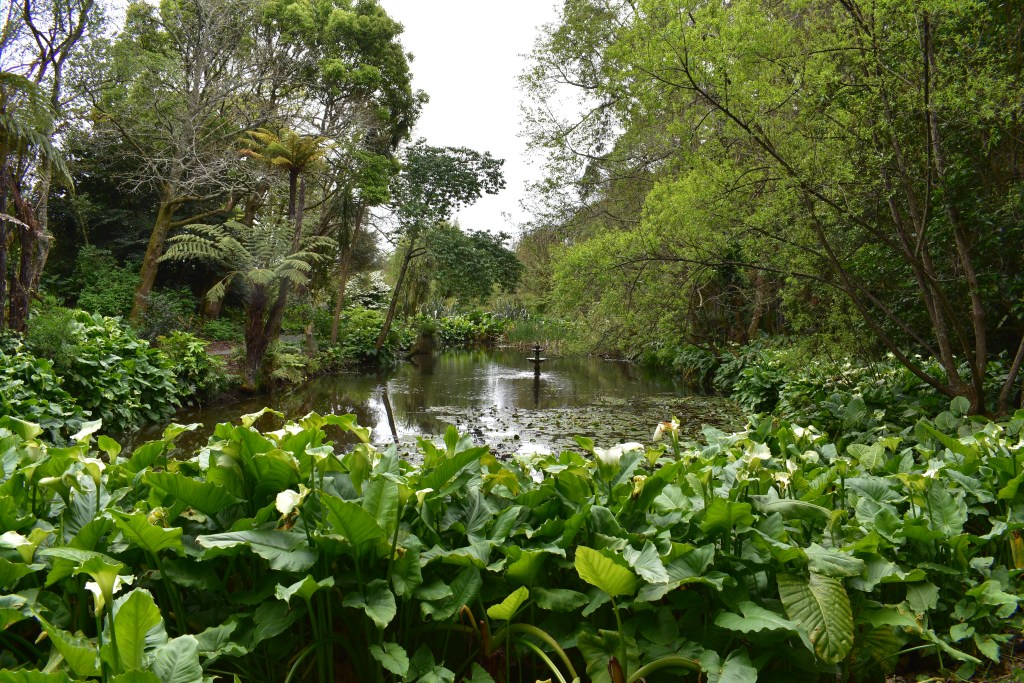
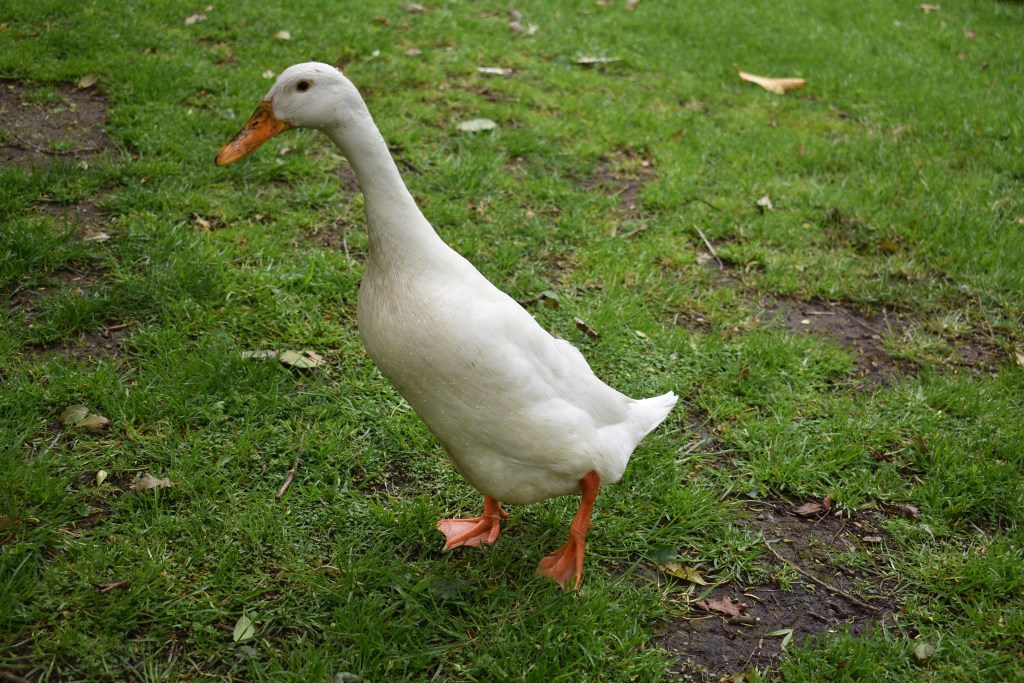
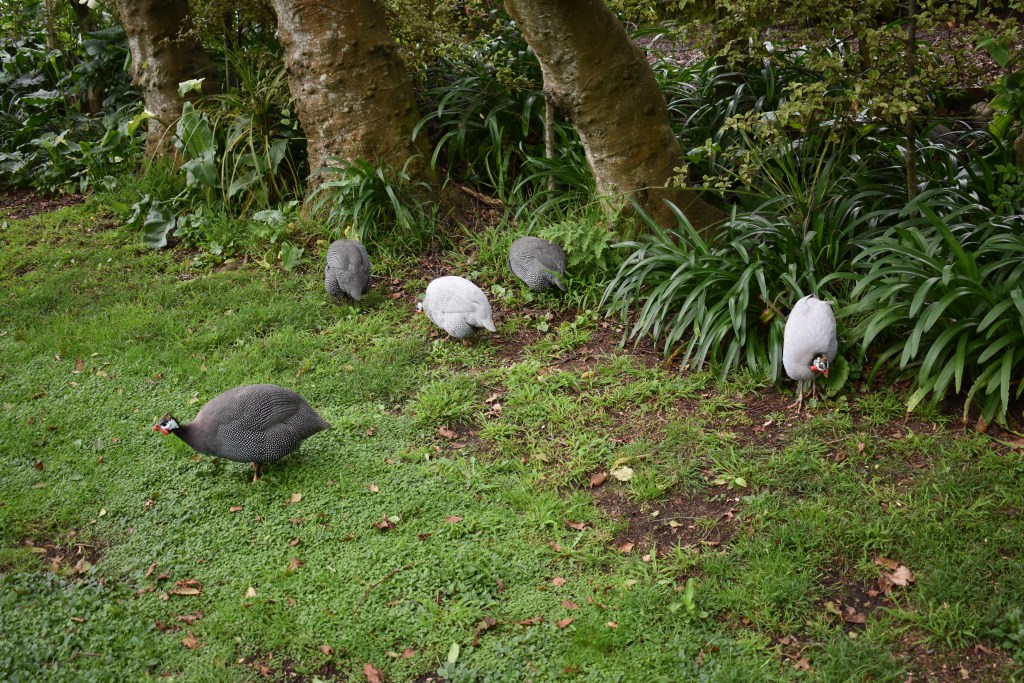
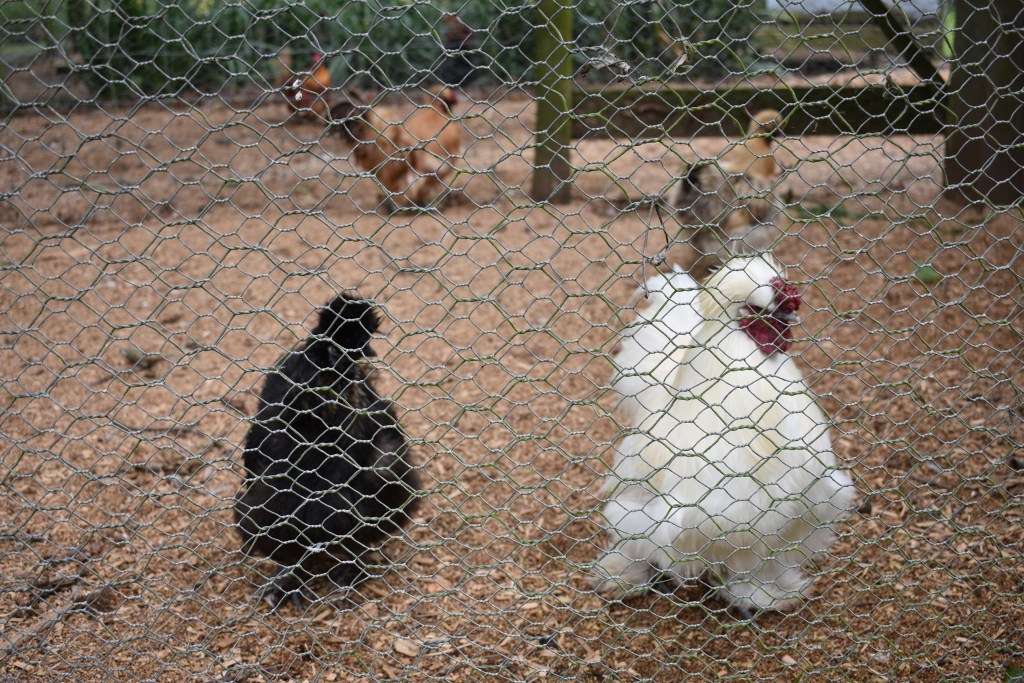

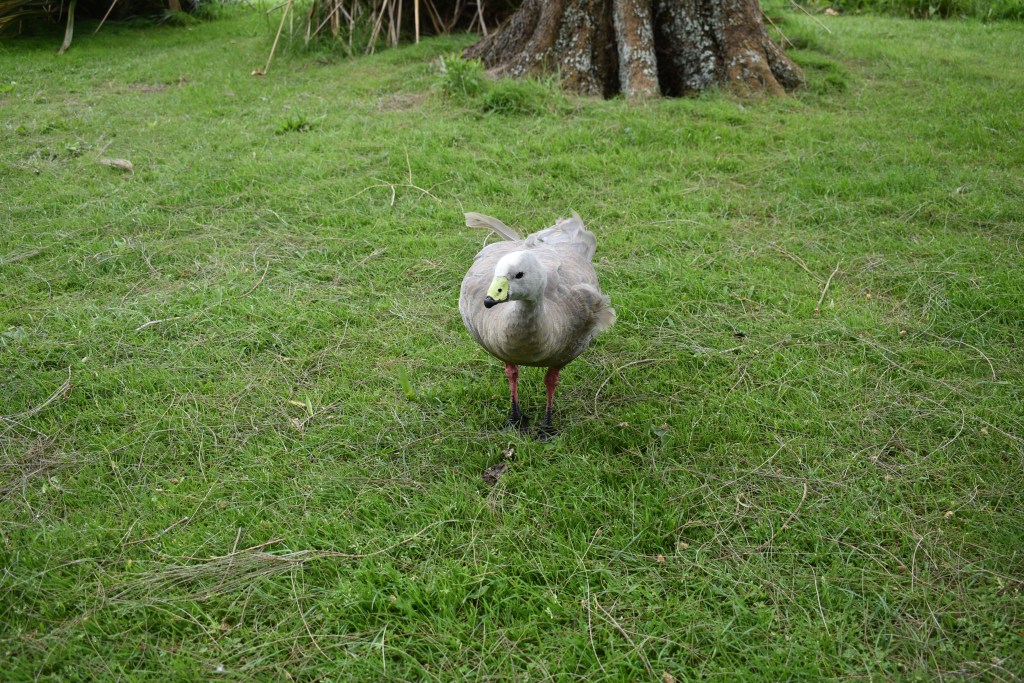
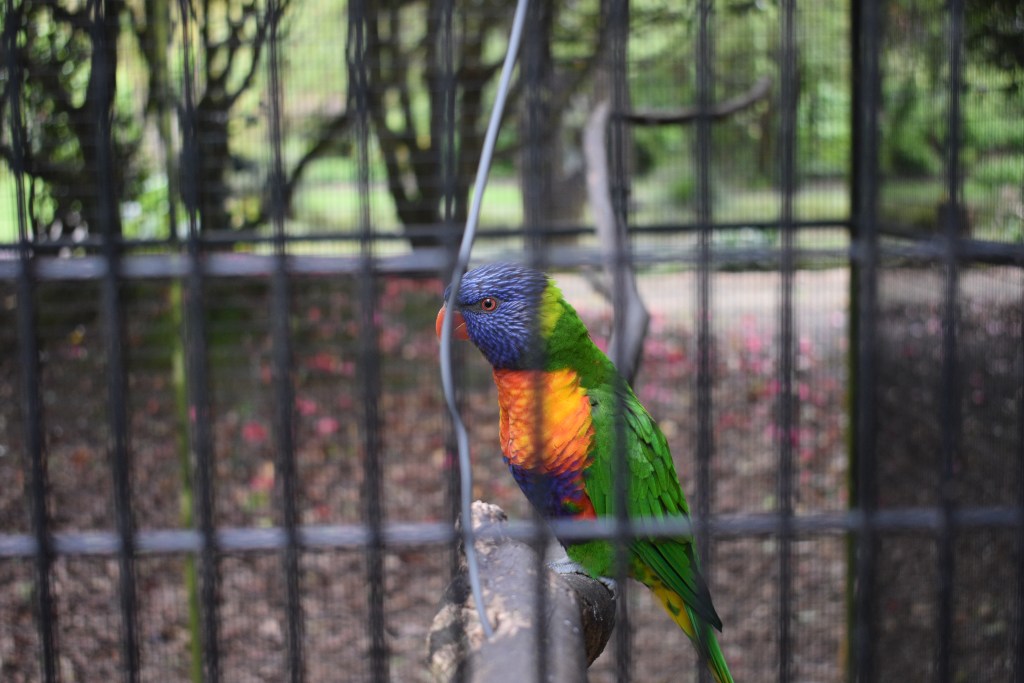
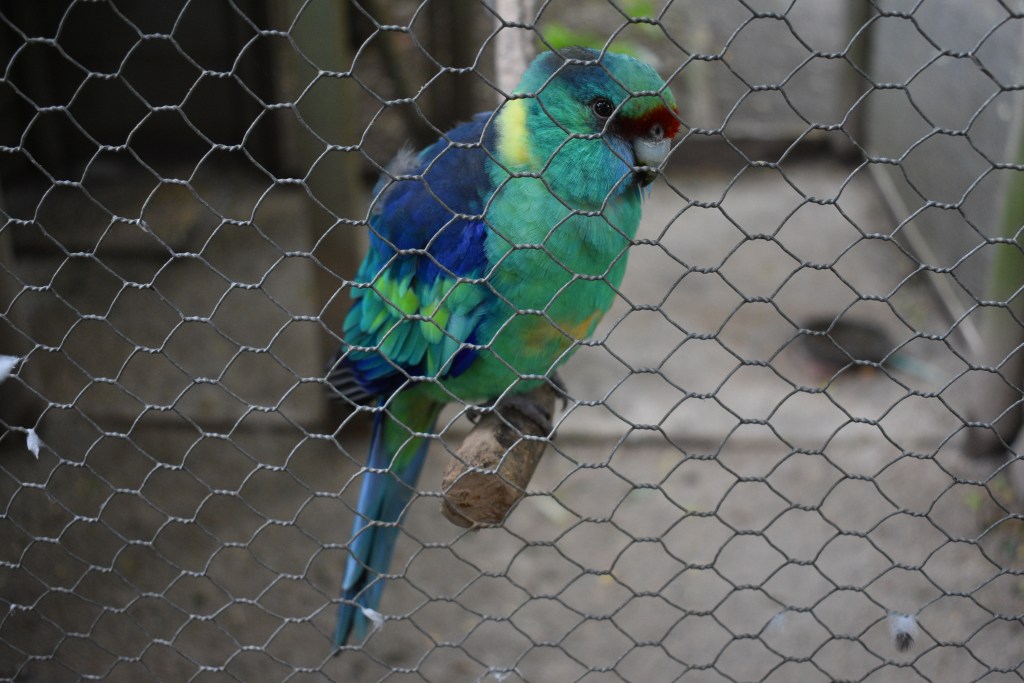
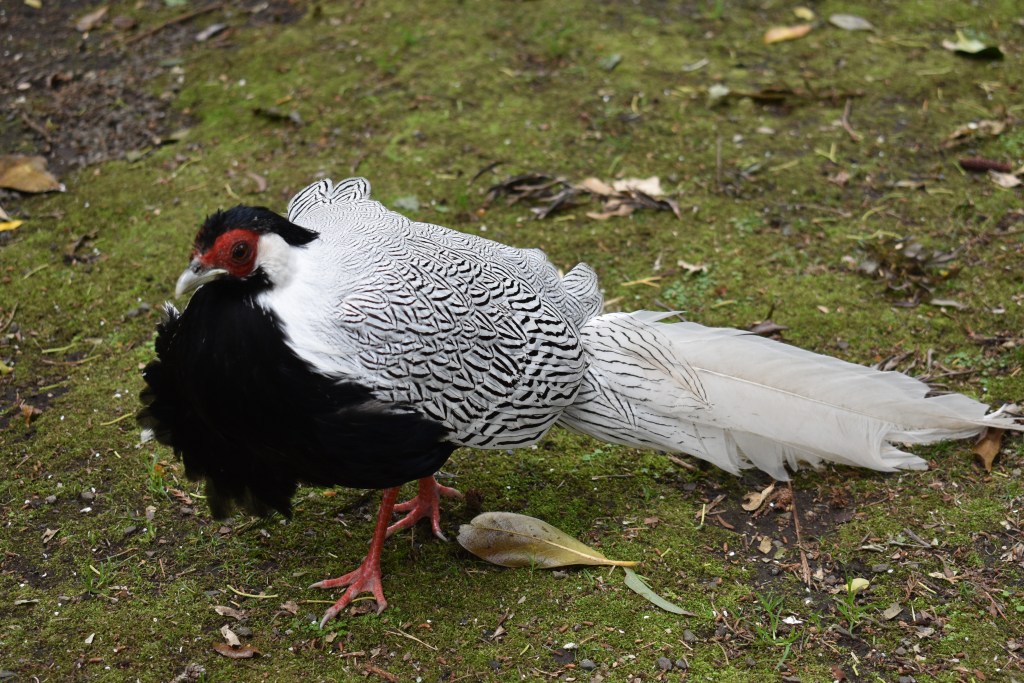

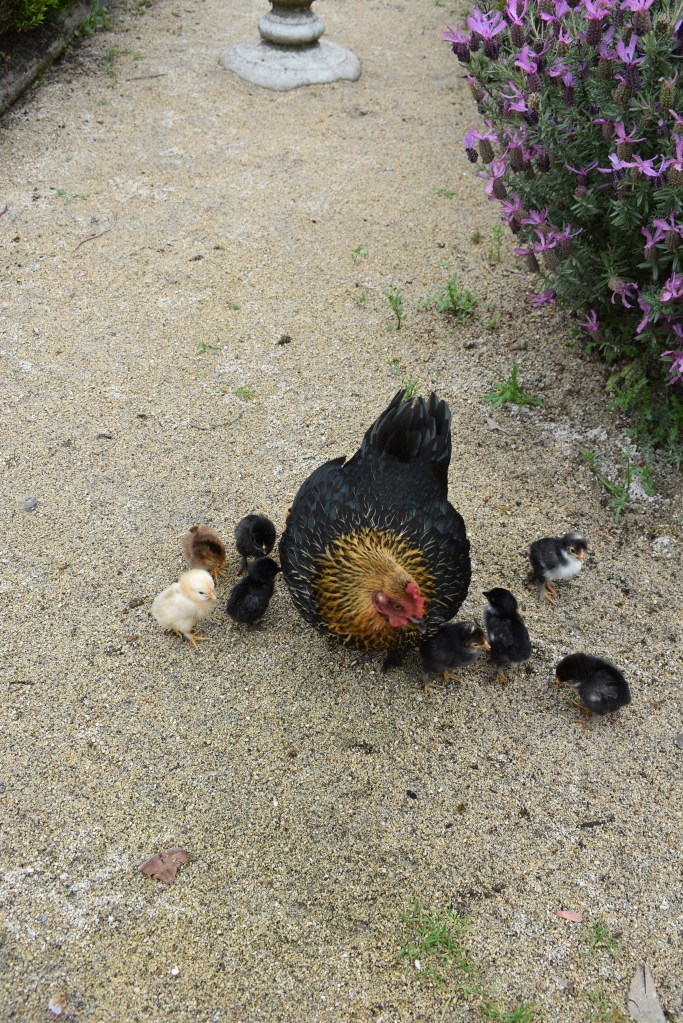
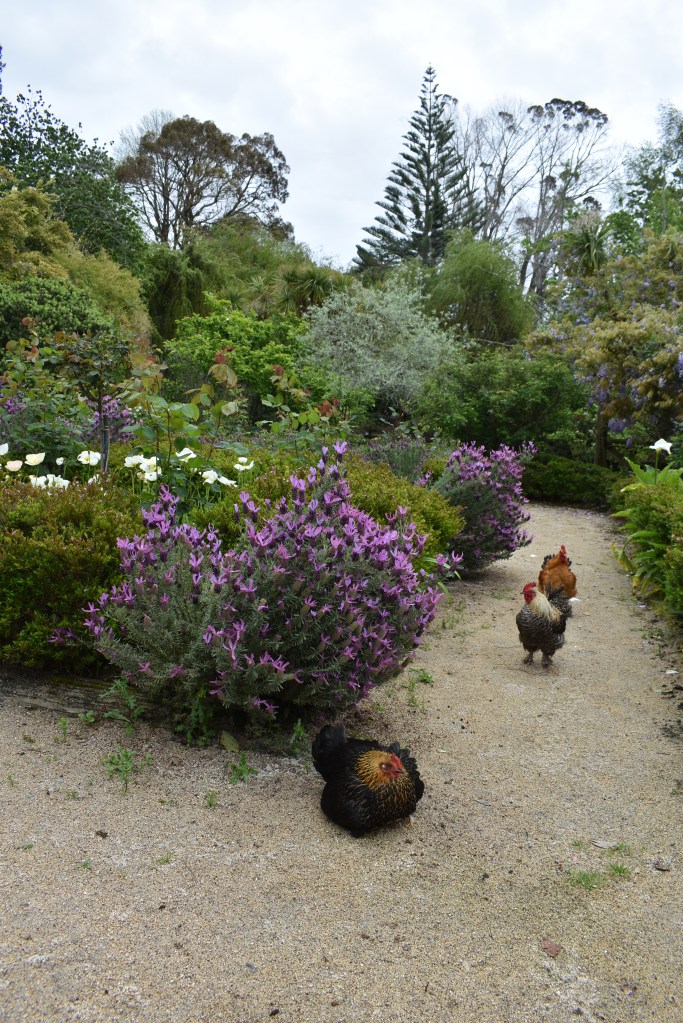
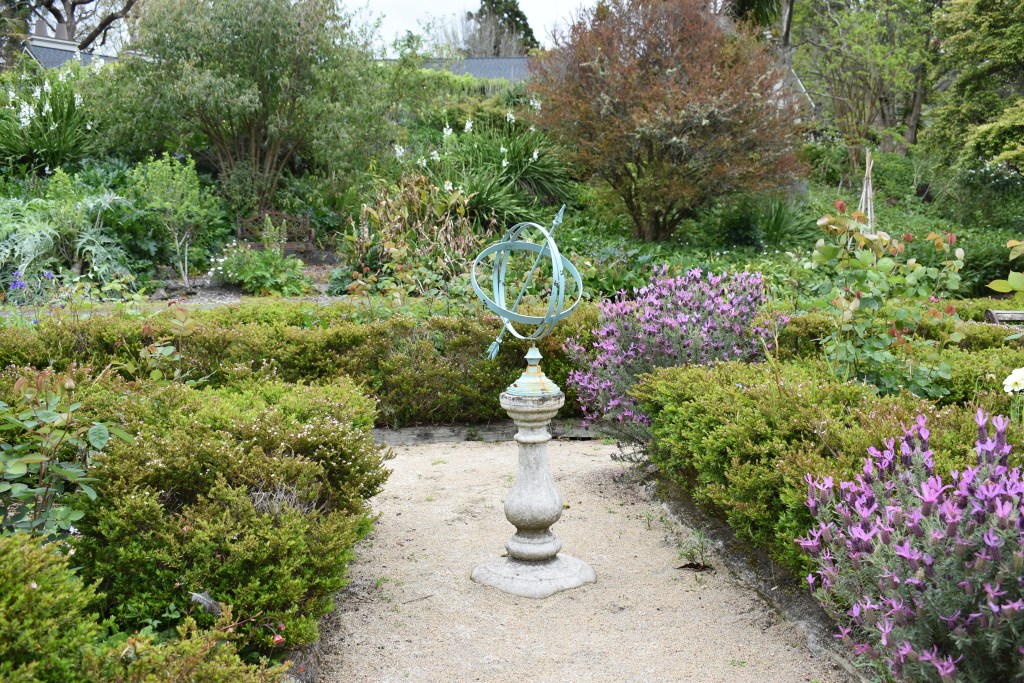
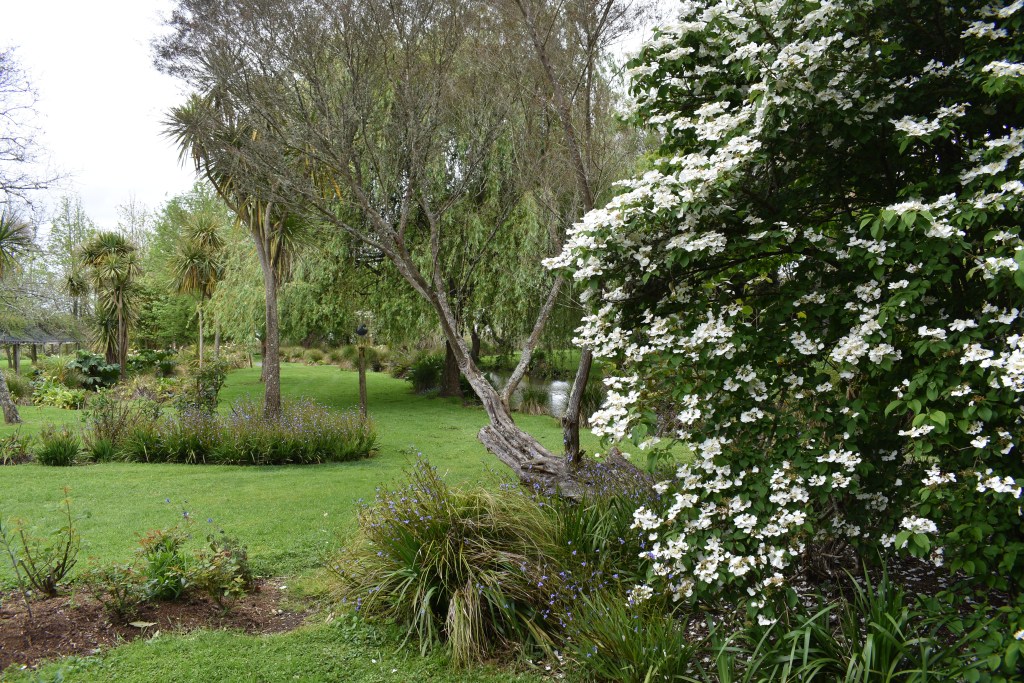
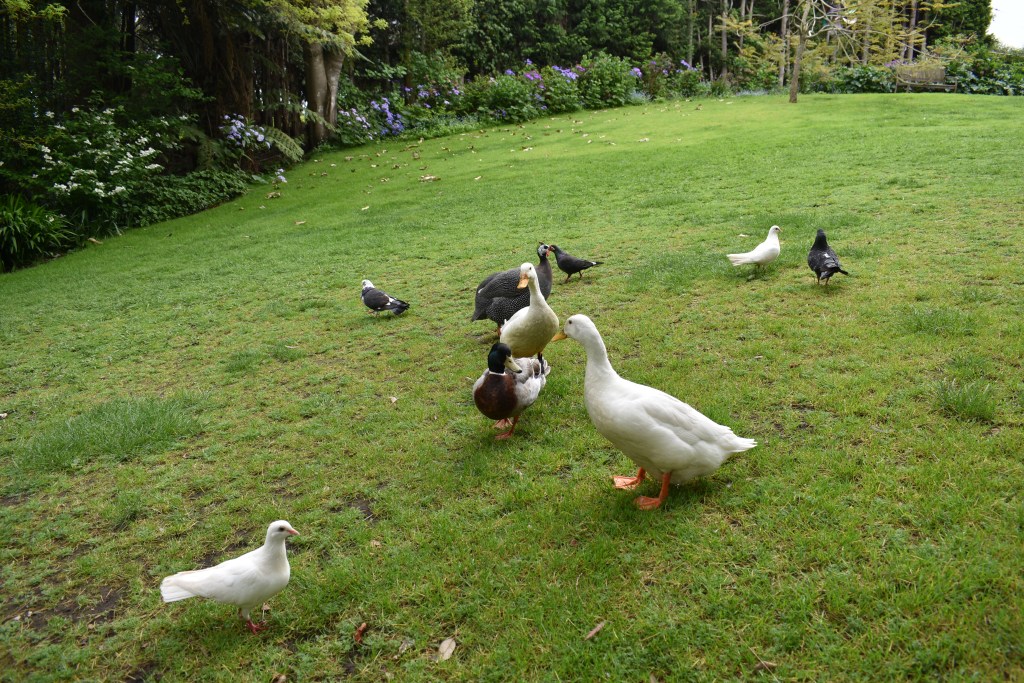
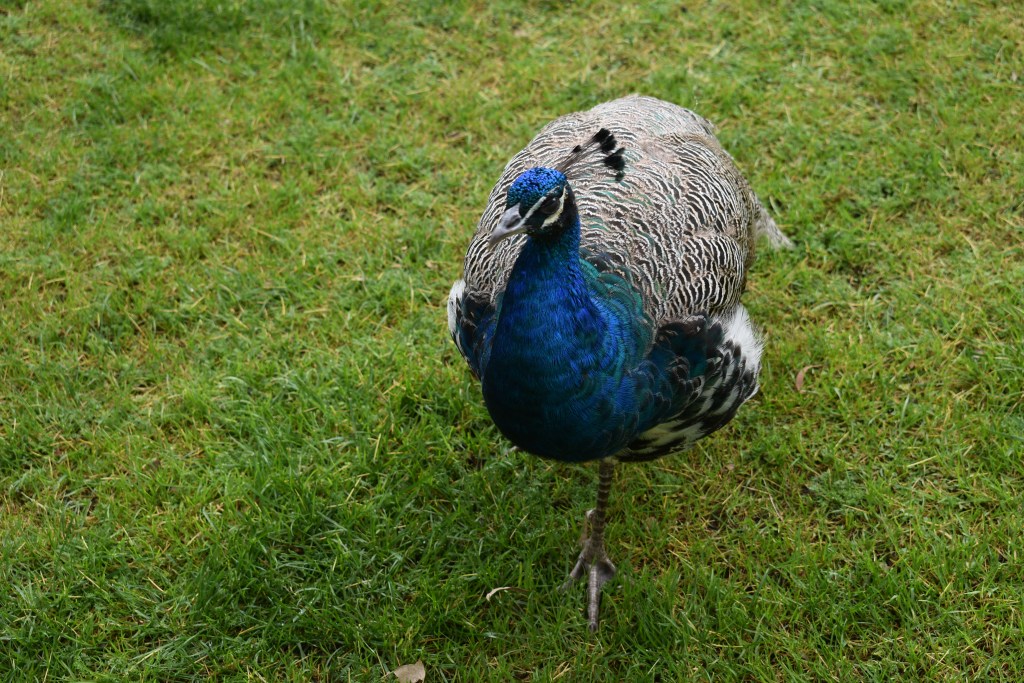
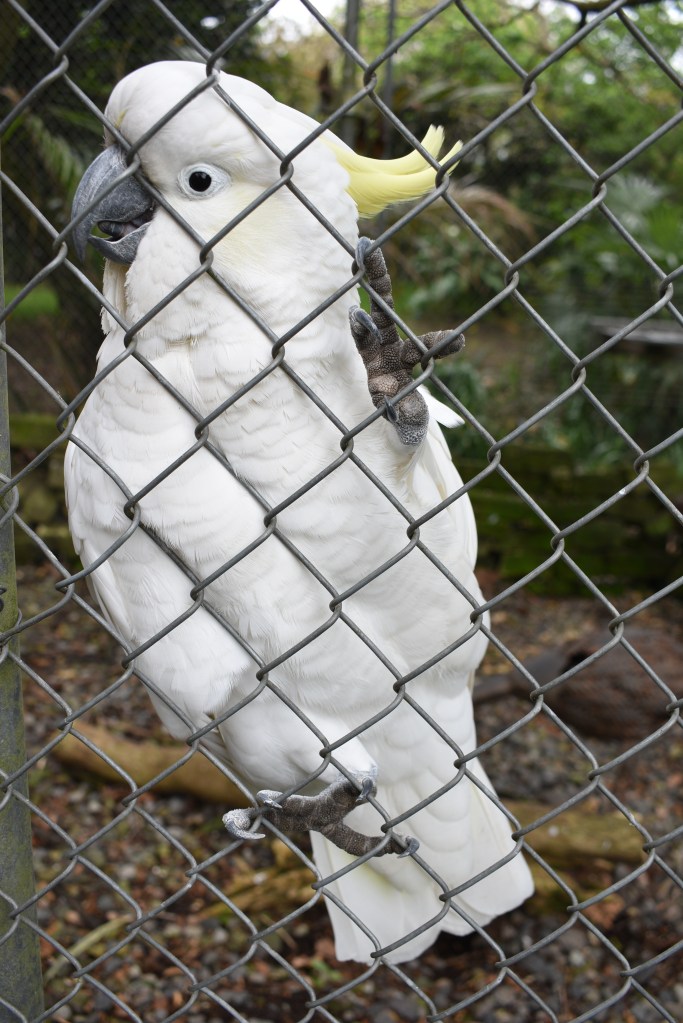
After wandering round I decided it would be rude not to have tea and cake despite the fact it was midday. At that stage I was the only visitor and chatted to the owner, who I invited to sat join me, about Brexit, Trump and other depressing subjects. He told me his wife was in England with her mother (who lived in Bradford on Avon) as her partner had recently died suddenly. I could have chatted longer but decided to make my way to Karangahake Gorge, which was the main item on today’s itinerary.
On the way I passed through Waihi and decided to stop to see if Julie (my Airbnb host when I stayed in the town for 2 nights at the end of July) was in the estate agents where she works. I’d earlier asked if she’d be around to meet me for dinner tonight and she was so thought I’d pop in to arrange a time and place.
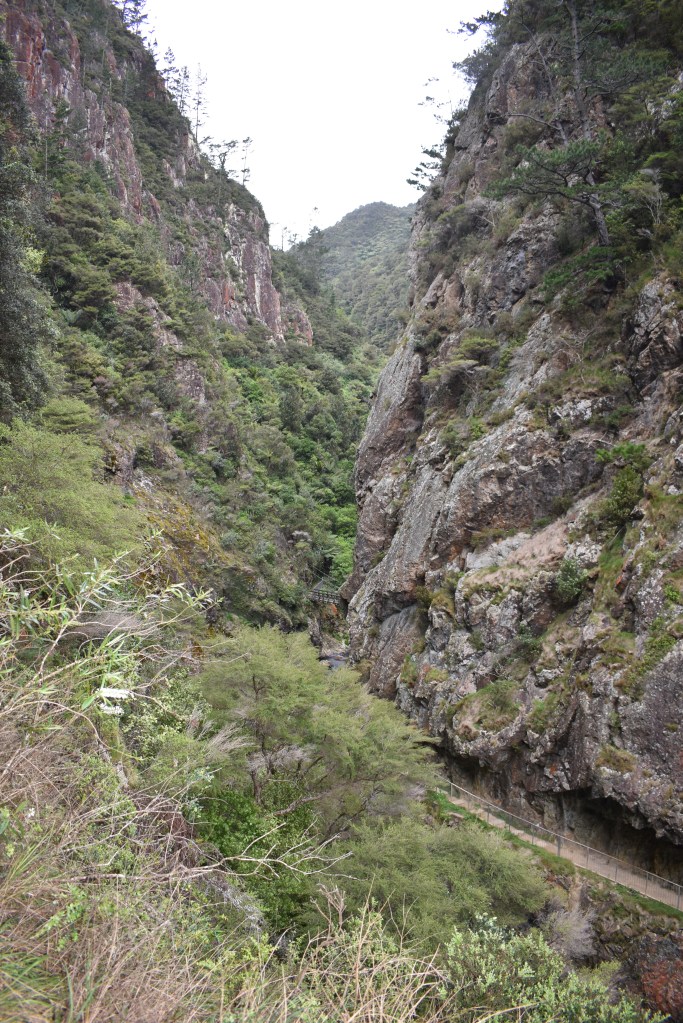
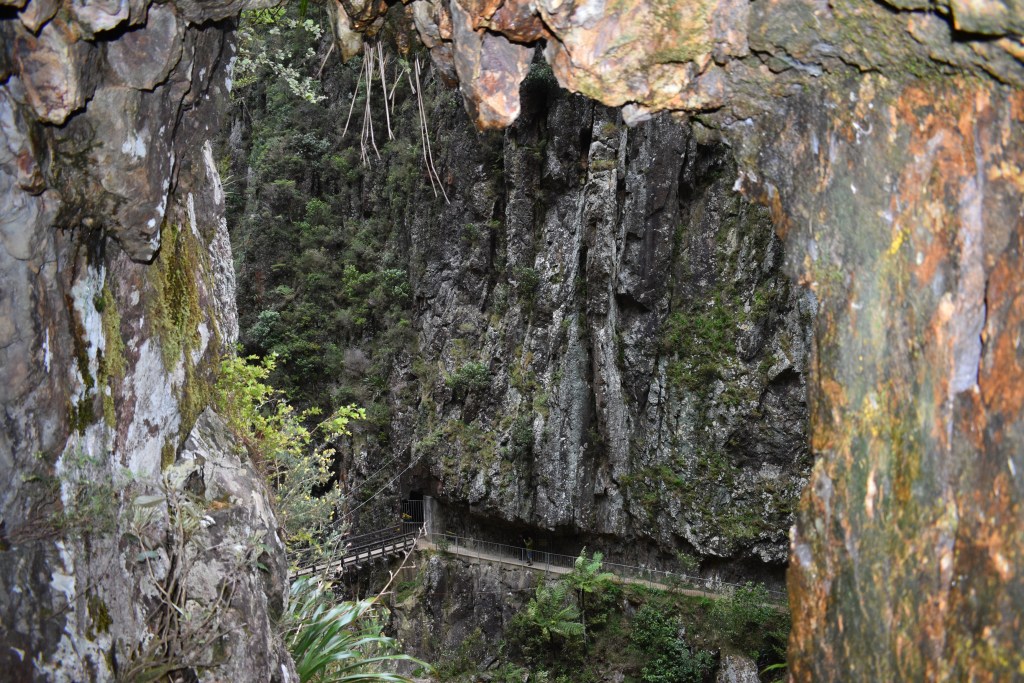
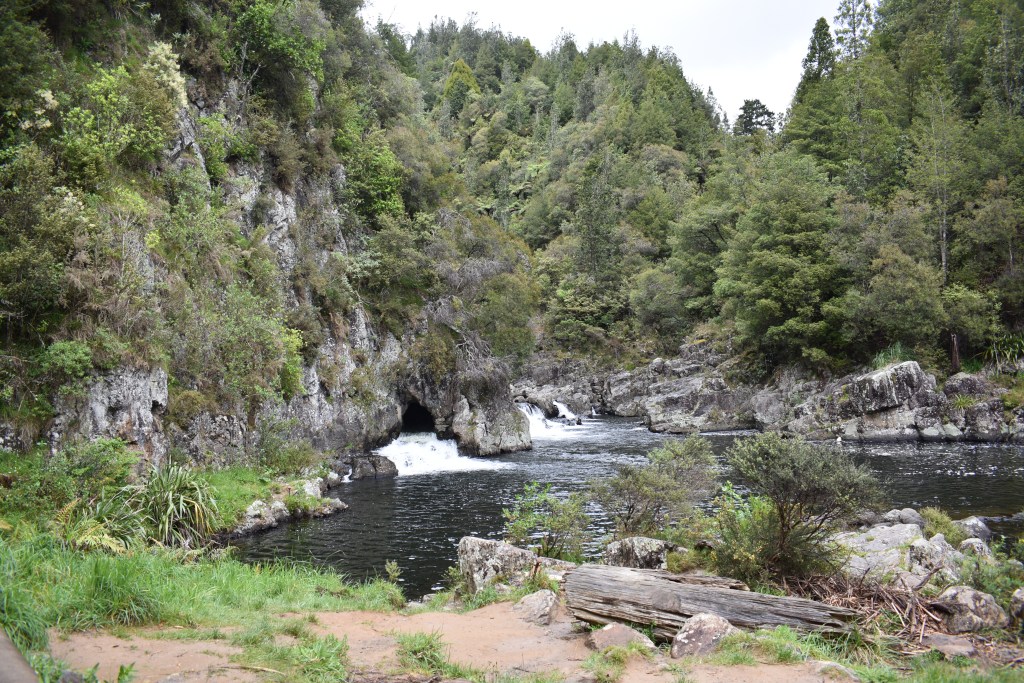
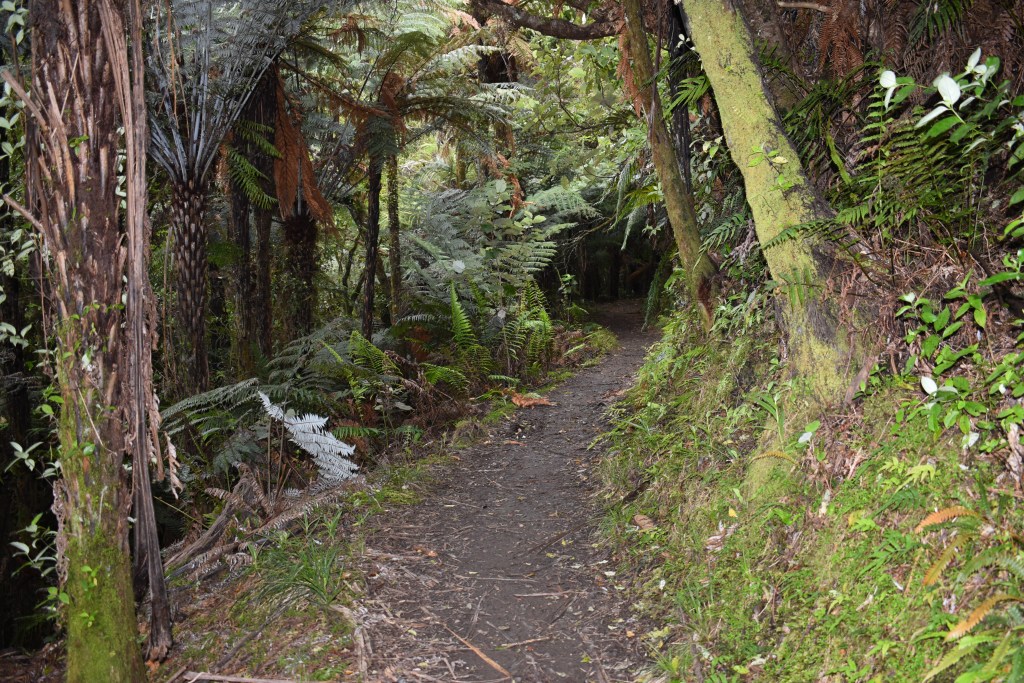
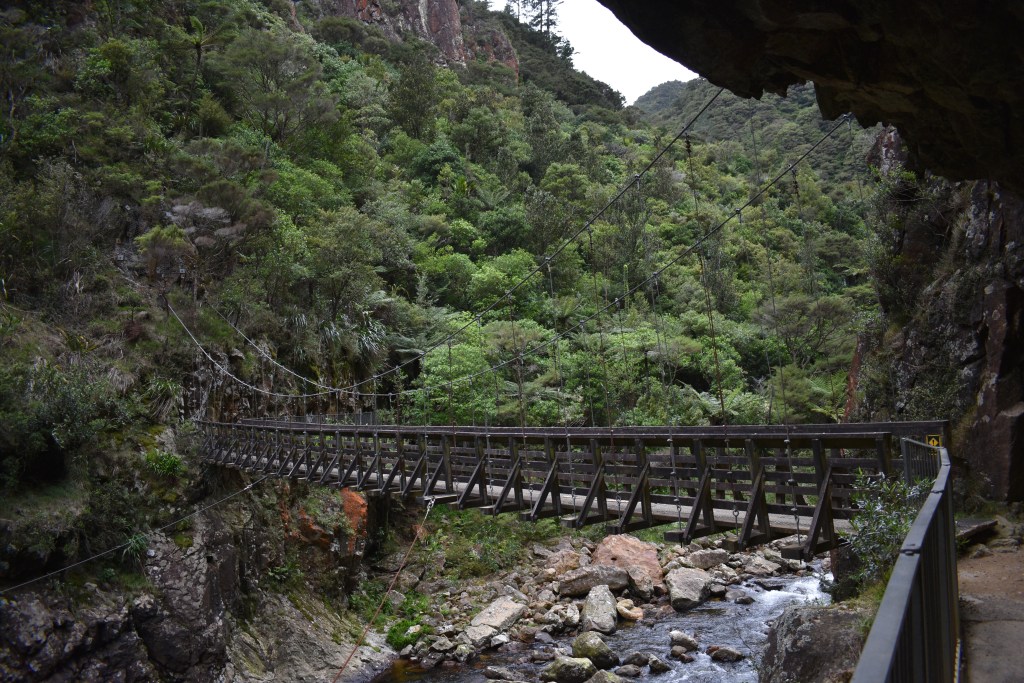
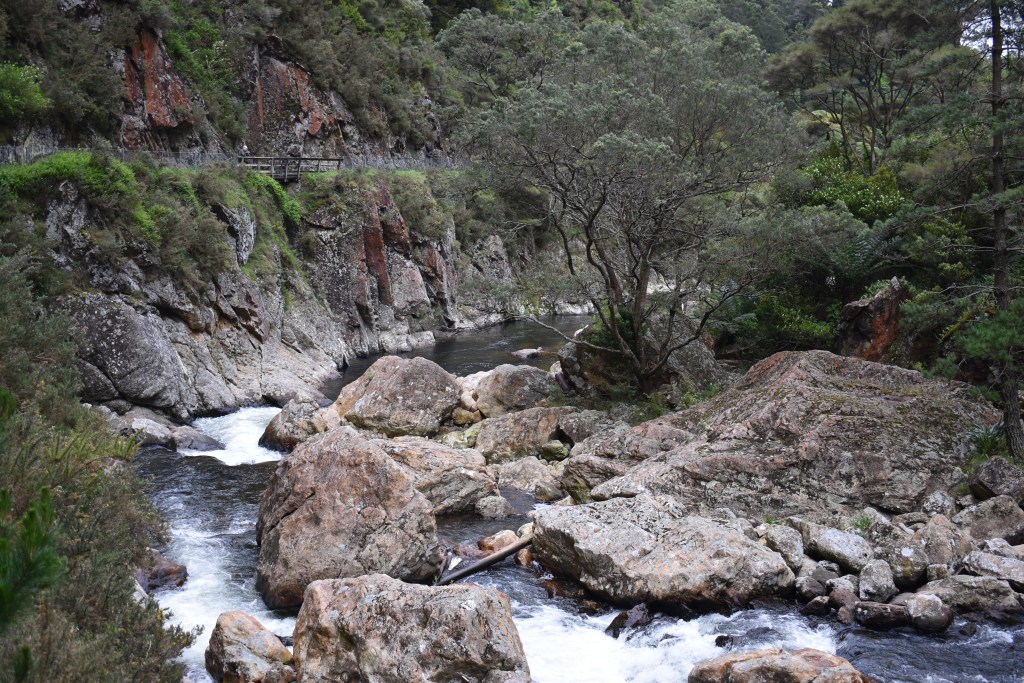
Although I’d been to Karangahake Gorge when I cycled through there from Waihi to Paeroa and back I hadn’t had time to do the Windows Walk which was recommended, so this was the reason for returning. This walk, while quite short, is interesting along a series of tunnels cut through the rock and various ‘windows’ along the way, presumably to let light in although a torch was still necessary. The tunnels are connected by a 500 meter tramway reached initially by walking over 2 suspension bridges and the area was where the richest ore for gold was found. When I came out the other end I continued walking along the lovely path in the gorge through the ferny bush for 30 minutes when I came to some small falls and another tunnel. The tunnel looked a bit dodgy and the walk went on for some way so I decided to return as it had started to rain. I returned to the car park on the path opposite the tunnels. I enjoyed this walk immensely and was glad I’d returned to the area for it.


I drove straight to Paeroa where I’d booked one night in an Airbnb hosted by Glenys and Alan. I hardly spoke to Alan but had a lovely chat with Glenys who told me all about her family. She had a wonderful sepia picture of her grandfather as a toddler with his father, grandfather and great grandfather the latter who was the first to come to New Zealand aged 42 in the 1850s. Glenys’ great great grandfather had been a bootmaker and when the gold mining took off in Thames he moved there to make boots for the miners, which must have been quite lucrative.
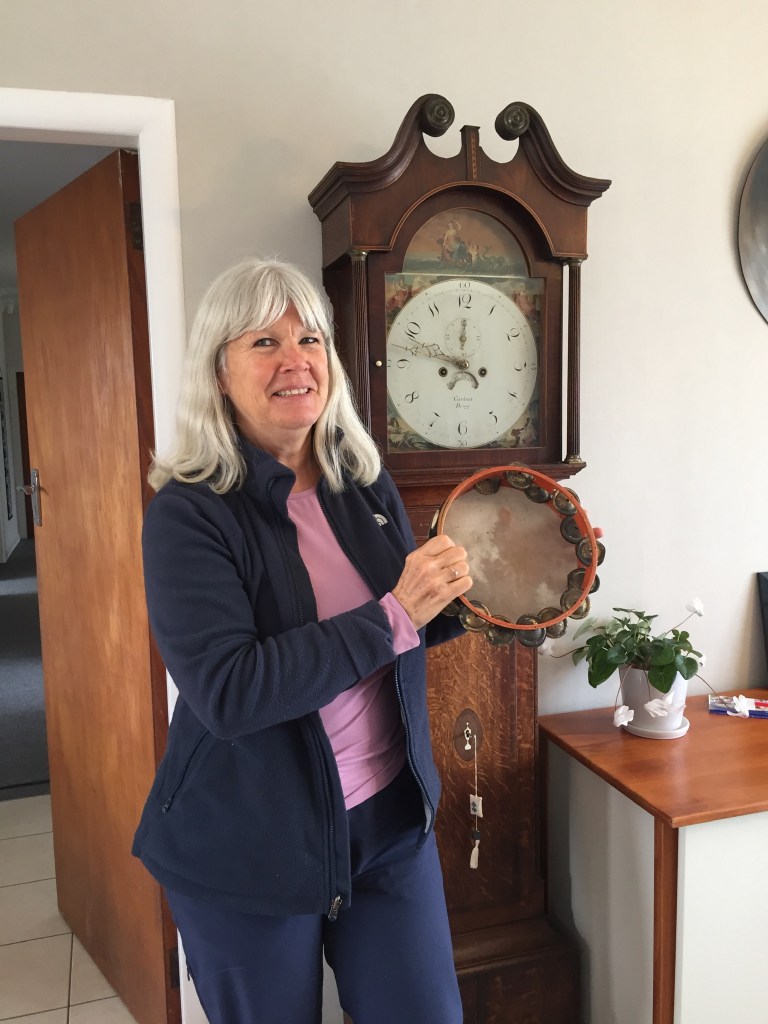
Glenys told me the shop premises still stands in the main street, no longer bootmakers, and had a contemporary drawing of it on the wall. She also had a grandfather clock which had been made by her 4 times great grandfather which her 3 times great grandfather had brought over from England. It was one of 3, one having been sold in London and the other whose whereabouts she didn’t know.
I noticed a tambourine on a shelf and wondered if there was a Salvation Army connection. It turned out that there was as a female relative of Glenys had been one of the earliest Salvationists in NZ and it was her tambourine from 1906. Of course I had to have my picture taken with it in front of the grandfather clock, mainly for Margaret’s benefit which will make her laugh (private joke!):
I told Glenys about the research I’d been doing into family history and she showed me her family tree thus far on Ancestry.com which she’d signed up to for a year which was interesting. I then rushed off to meet Julie for dinner in town who told me she’d also signed up and showed me her family tree so far. It was lovely to see Julie again and have a catch up since we first met at the end of July. She’s looking forward to going to London in December to see her son and his girlfriend and told me again that she feels more English than NZ.
The weather forecast hadn’t been looking very good for that evening and it rained quite heavily during the night, with the wind really blowing and rain battering on the window. I woke to discover that someone had drowned near Auckland when their boat capsized and his wife was in hospital. I can’t understand why anyone would have been out in a boat in such weather. In the morning a siren sounded, rather like I imagine the sirens in the War to alert people to go to their local air raid shelter but Glenys told me it was to alert the volunteer firefighters to go to the station as their services were needed!
So, given the weather, it was a leisurely breakfast on Tuesday morning, Glenys telling me there was no need for me to rush off. We chatted again, mainly about ideas as to where I could go with the next gap I have between a housesit in Whitianga and Bay of Islands visit, which was really helpful. It will make sense for me to hire a car again, especially at the brilliant rate I got. We thought it unlikely that I’d be able to do my planned ‘Pinnacles’ walk tomorrow (a listed ‘must do’) as the road to the start would likely be flooded and the walk (quite long and steep) would be extremely muddy and slippery. I would have the option of doing it on Thursday if the weather improves so will see. But I shall be disappointed if I can’t as it’s the main reason I’m returning to Thames.
Glenys suggested I might enjoy a visit to Miranda Shorebird Centre before going to Thames so I headed there, accompanied by the rain. There were some hides but, given the poor weather, thought it wasn’t worth the effort – a shame as this is one of the most accessible spots for studying waders or shorebirds all year round. The vast mudflat teems with aquatic worms and crustaceans attracting thousands of arctic-nesting shorebirds over the winter. 43 species of wader have been spotted here.
So instead of bird watching (not one of my favourite pastimes anyway) I just had a read of the information in the centre and looked at the gift shop. I was particularly interested in the birds that can only be found in NZ: the NZ dotterel, variable oystercatcher, wrybill, South Island pied oystercatcher, shore plover and black stilt. There was one other couple looking around and I detected an Irish accent so asked the man if I was right. He (Gerry) said yes, that he was from near Dublin and his wife (Johanna, 15 years his junior) was German. We chatted (about Brexit again!) and, as they were also going to Thames tonight, arranged to meet up for dinner at the Grahamstown Bar & Diner or GBD as it’s known locally. That was one of the places I’d visited before and had a good meal and service.
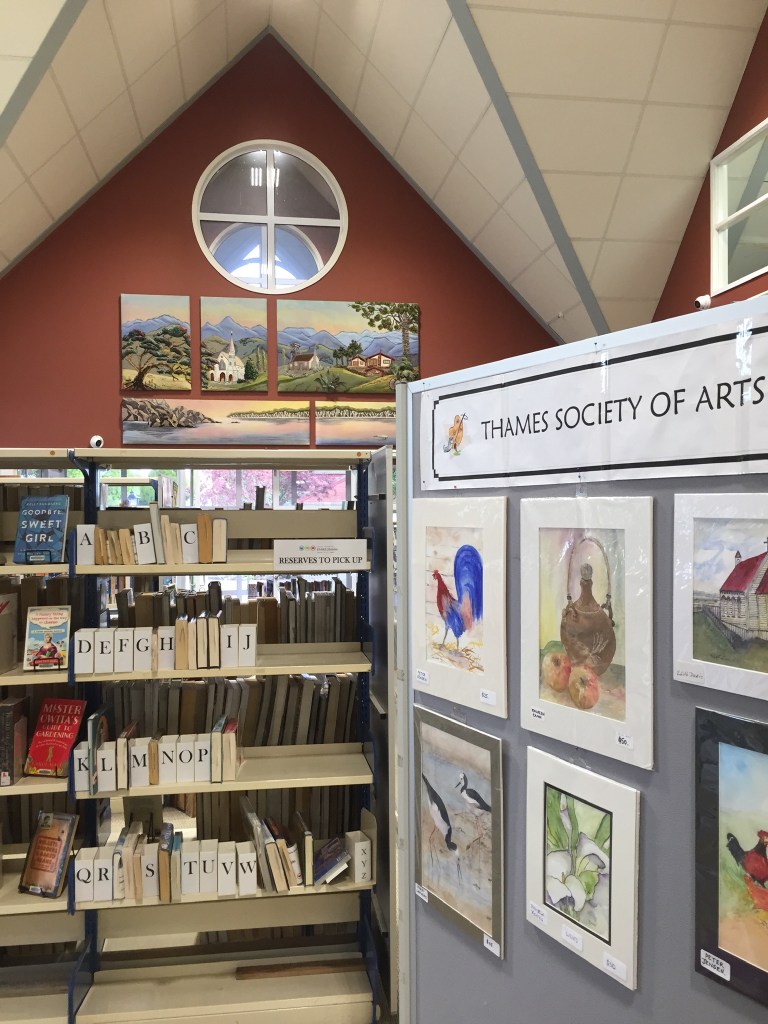
I drove to Thames and spent a couple of hours in the library and was soon joined by some French travellers who got out all their chargers to charge up their phones and laptops. The library had a lovely stained glass window, a mural and exhibition of some of the artwork of the Thames Society of Arts:

I’d arranged to be at the Airbnb I’d booked for 2 nights by 5pm. The house was right at the top of a hill, an area of Thames I hadn’t explored before and, like Tauranga on my second visit, I thought that Thames had more charm than I’d accorded it the first time.
My hosts weren’t in when I got there but arrived about 5 minutes later, my first impression of them not great as I got a curt “hello”, was told to move the car and no offer to help with my bags as they just walked into the house. I stood on the doorstep and asked for help with my suitcase and they looked at each other so I said never mind I’d do it myself which then prompted Anthony (Kiwi firefighter) to assist. There was then no offer of a cup of tea, which has usually been the first thing hosts do and is always welcome. When I asked Eva, my first impression of her being a German smiling assassin, if she needed to explain anything she said it was all in my room. When I read the notes it seemed to be quite unwelcoming as it was a list of things I shouldn’t do: the kitchen is out of bounds, the bath is not for your use, don’t eat in the bedroom (fair enough) and so on. I thought this should be fun (not) and soon after sorting my things out walked down into town to meet up with Johanna and Gerry in GBD. Seem to be having a spate of unfriendly hosts.
Fortunately Gerry had checked with GBD earlier and was advised to book a table. Just as well as the place was full for a quiz night and it was rather noisy. I mentioned to Johanna and Gerry that I’d booked to do the Coastal Walkway on Friday with a company called Coromandel Adventures but that it was unlikely to run as they needed more than one person. As luck would have it they had wanted to do this walk but thought they couldn’t as knew they couldn’t drive on the unsealed road there (not recommended and not allowed by my hire car company) and hadn’t heard of this tour so were keen. Later they texted to say they were going to book it for Saturday and their daughter Lotti, who’s studying for a PhD in Auckland, would join them. I contacted the company who swapped me to Saturday and offered to pay for the railway trip I’d booked for the Friday as a thank you for introducing them to the company and their bookings.
When I got back to the Airbnb Eva made conversation with me and the next morning (Wednesday) over breakfast she and Anthony joined me. We had a good chat so I decided they weren’t so bad after all, that maybe they’d had words the day before and realised they’d been unfriendly towards me so we’re making amends. Eva said they’d had over Airbnb 600 guests in the 2 years they’d been hosting, although I thought that might be an exaggeration. Their main room, kitchen/diner/lounge combined, had the most fabulous view of the estuary which is where the big Waikato River discharges. Eva has lived with Anthony for 3 years and travels back to Germany regularly as she misses her 2 daughters and grandson with another grandchild due. Anthony, who’s been married twice before, also has 2 daughters and a grandson. I guess this must cause problems as Eva would like to return permanently to Germany but with Anthony. Eva is extremely talkative and it was difficult to make my escape.
I decided to drive to the Kauaeranga Valley Visitor Centre (14km out of town) in the Coromandel Forest Park to see how likely it was I could do the Pinnacles Walk the next day. When I got about 2km from it the river was running across the road and I didn’t dare drive across so decided to try on Thursday when hopefully the water should have lessened. I had intended to move on from Thames the next morning but as the walk is supposed to be ‘not to be missed’ wanted to attempt it.
I paid a visit to the Thames Goldmine Experience which I hadn’t even noticed on my first visit, joining a small group of people led by the most wonderful guide, Peter, who was not only knowledgeable about the whole process of mining for gold, but about world history in general. With hard hats donned we were led into a tunnel where there were a couple of dummies, one pushing a trolley full of ore and another hammering into the rock. Peter told us that the first miners were from Cornwall as they had tin mining experience and brought to life the dangers that would have been faced in the early days. Then we went into the main building where we put on ear defenders while Peter turned on a stamper battery which had been used to crush the ore. Even with the ear defenders it was noisy but originally there would have been many more pounding away hitch would have reverberated around the whole town. There were two trays which sifted the small pieces of gold from the rubbish, this being the end of the process.
There was a short self guided walk around the grounds which even had a morgue. There were also some great old black and white photos of the mine in its heyday, miners, the town and an interesting dvd.
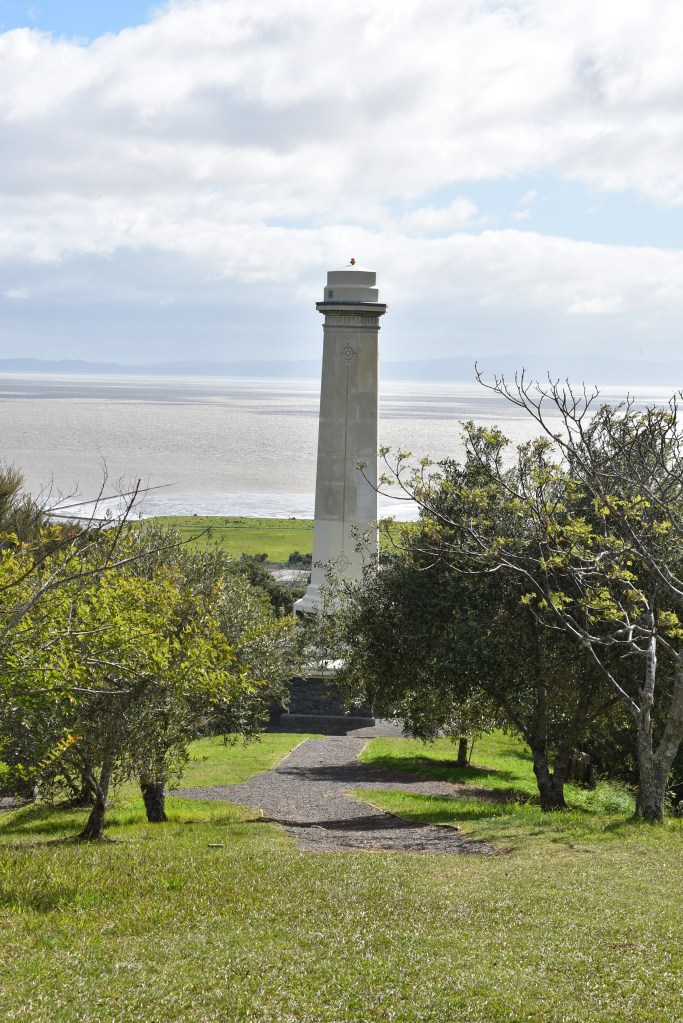
After lunch I went to the i-site office where a woman called the Kauaeranga Valley Visitor Centre for me so I could find out about prospects of the walk for the next day. They reckoned it would be fine and told me some people had driven across the road I’d avoided and were walking that day anyway, although understood why I hadn’t dared. I pottered around the town and drove up to a war memorial which overlooks the town:
I then walked the length of the shore walk (3.7km) and back which was rather bracing and returned to GBD, where I felt quite comfortable as the barman was very friendly, for a fish and chips dinner that I’d promised myself.
Back at the Airbnb, while Anthony was watching TV Eva was keen to talk to me, so we had another conversation and I requested breakfast for 7am the next day with the intention of leaving at 7.30am.
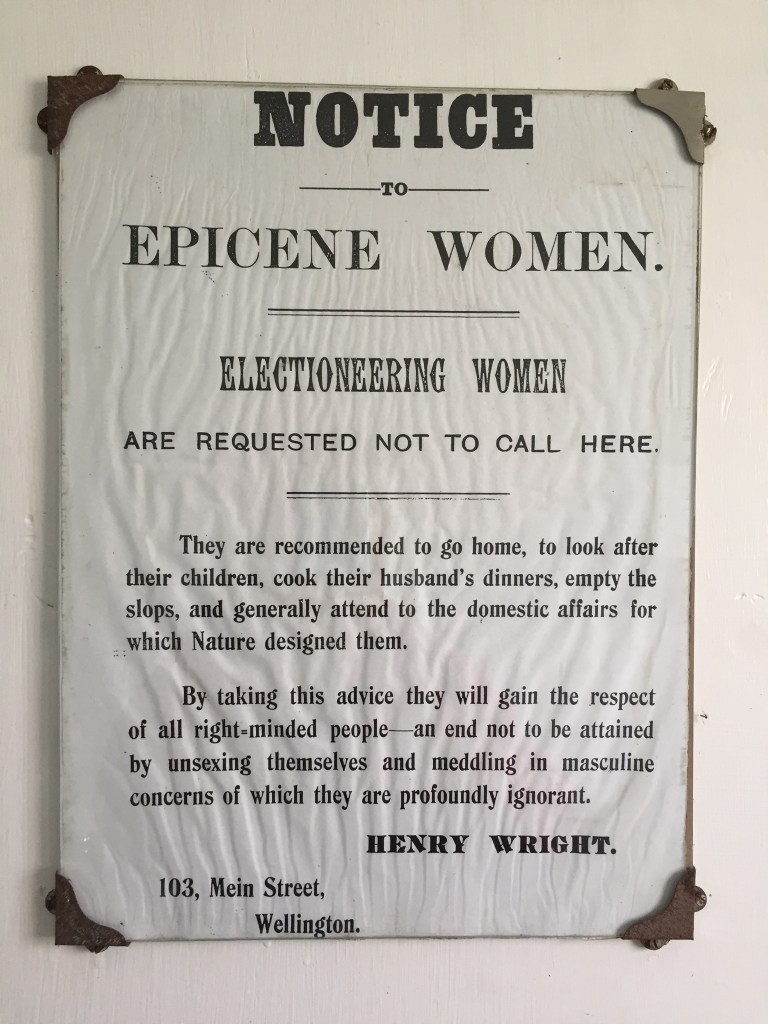
Notice at the mine 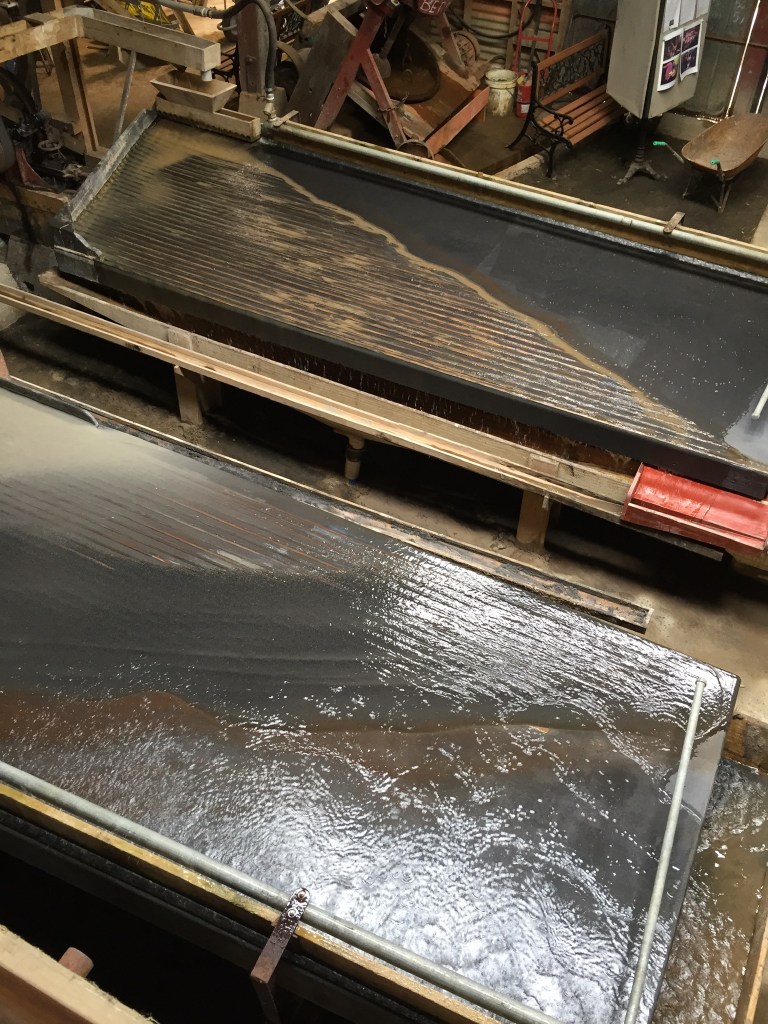
Final sorting of gold 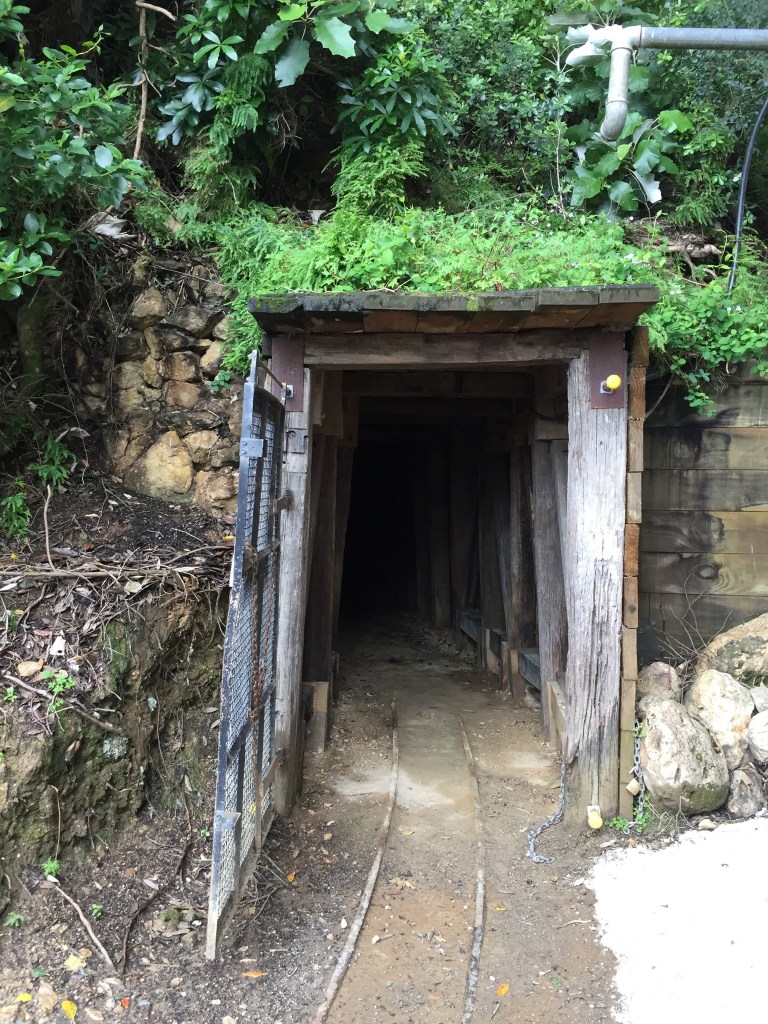
Entrance to mine tunnel
Thursday morning came and, although I was ready in time, Eva didn’t stop talking so I didn’t make it out of the door until after 8am. I got to the Visitor Centre and spoke to a lovely woman called Donna about the walk. The walk generally takes 2-3 hours to a hut, where some people stop for the night before then walking the 45 minutes to the actual Pinnacles (rock formations) the next day. Although I’d have stayed in the hut years ago it now would have been my worst nightmare so I’d decided to walk it all in one go.
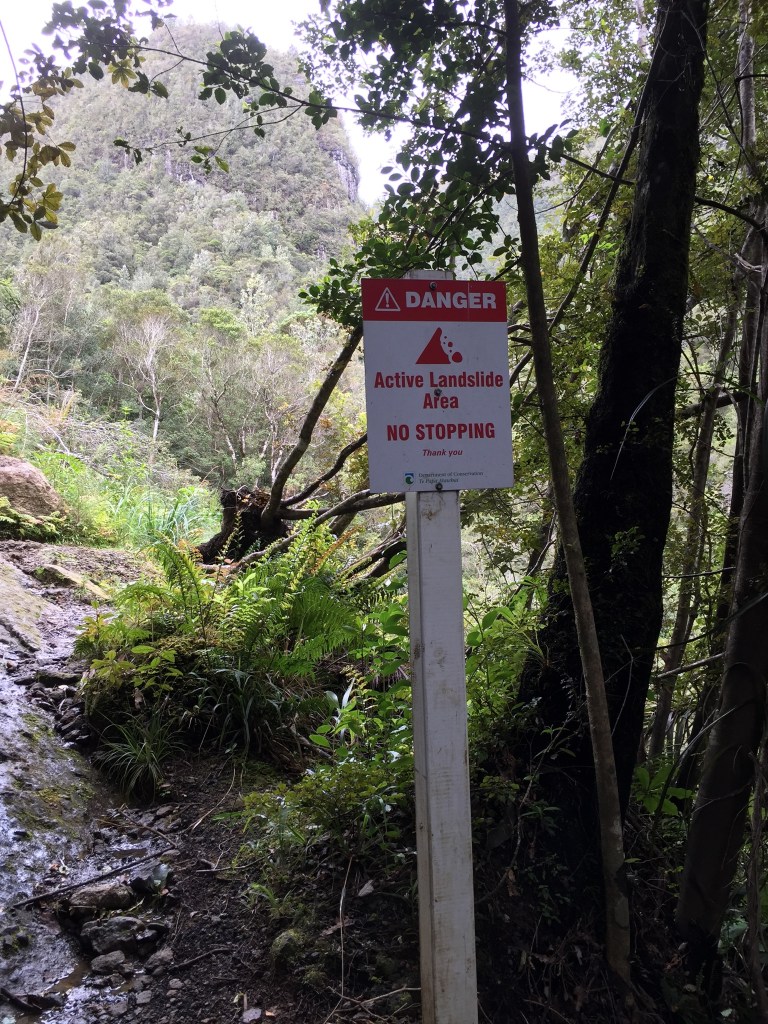
There was a 9km drive along an unsealed road to the car park at the start of the walk. Along the way were tracks to shorter walks and basic campsites. The Pinnacles walk follows an historic packhorse route used by kauri bushmen in the 1920s and is graded intermediate. The walk started along a gravelled path, then across a narrow swing bridge and up through the forest to a wider swing bridge and more uphill mainly on rocky steps. Fortunately the uphill sections were broken up by short flat sections in between so it wasn’t too arduous. The views were magnificent if obscured a little at times by cloud. I met about 5 people in all coming back down having either set off very early or stayed in the hut last night. I saw this rather interesting sign on the way but obviously ignored it to take a photo:
It took me two and a half hours to get to the hut where I stopped to have a quick snack. I looked into the hut and thought I’d definitely made the right decision not to stay. While it’s in a fantastic location, the facilities good and appeared to be well maintained, the bunk room reminded me of an upmarket concentration camp having two long platforms, one on top of the other, and single plastic covered mattresses for people to lay on side by side like sardines. My decision not to stay there overnight was reconfirmed when on my way back down later I passed hoards of youngsters walking up to spend the night there, some of whom were doing it as part of their ‘Outdoor Education’ for school.
From the hut, the actual ‘Pinnacles’ were said to be 45 minutes walk and this was mostly up hundreds of steps (man made) which on the way day I counted (540) so that was pretty tough. After the steps there were two vertical iron ladders to climb with rocks to negotiate in between, some iron rungs that had been attached to rocks, and more rock clambering. I couldn’t have done most of the walk without my walking poles although of course none of the youngsters had them. It took me an hour to get up to the viewing platform amidst the Pinnacles which afforded commanding views of the forest and Thames in the distance at a height above sea level of 759m. Soon after I got there, a couple arrived on the platform and decided they’d ignore the ‘Danger. Do not cross. Sheer drop’ sign and clamber up higher to look the other side of the rocks. They offered to help me up saying it was worth it but I declined!
I’d walked up via the Webb Creek Track and back the same way. There is an alternative way down (or up) via the Billygoat Track but Donna had advised me to steer clear of that as I’d be knee deep in mud after the recent rain. I was so glad I’d done the walk but when I got back down (all told the walk took me 6 hours) thought that if I’d known how hard it had been I would probably not have done it!
Some of the views going up to the Pinnacles and from the top:
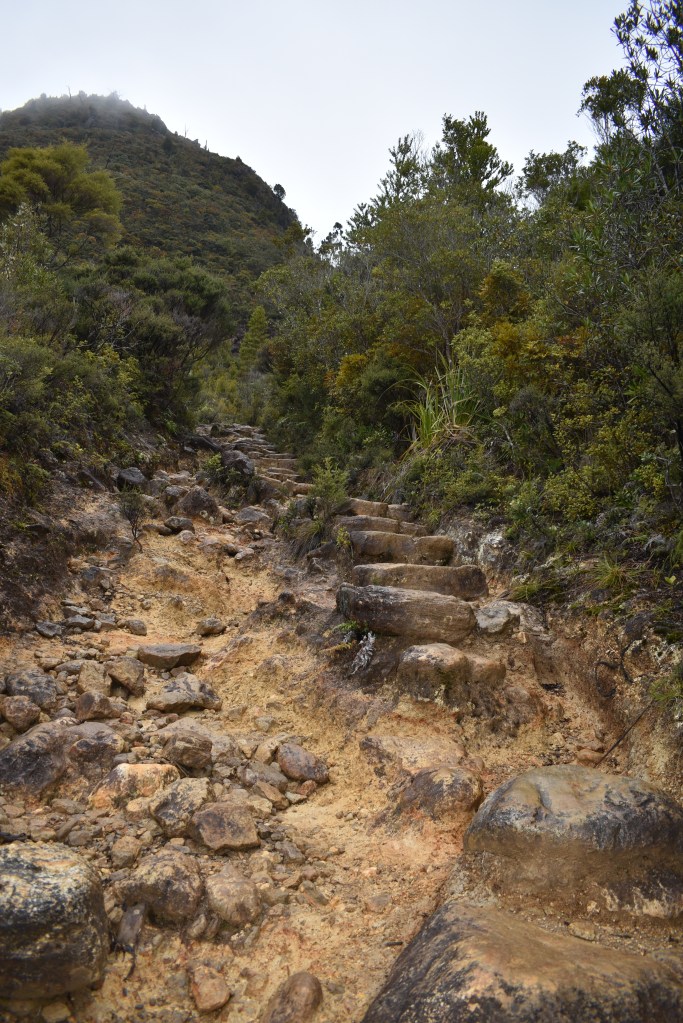

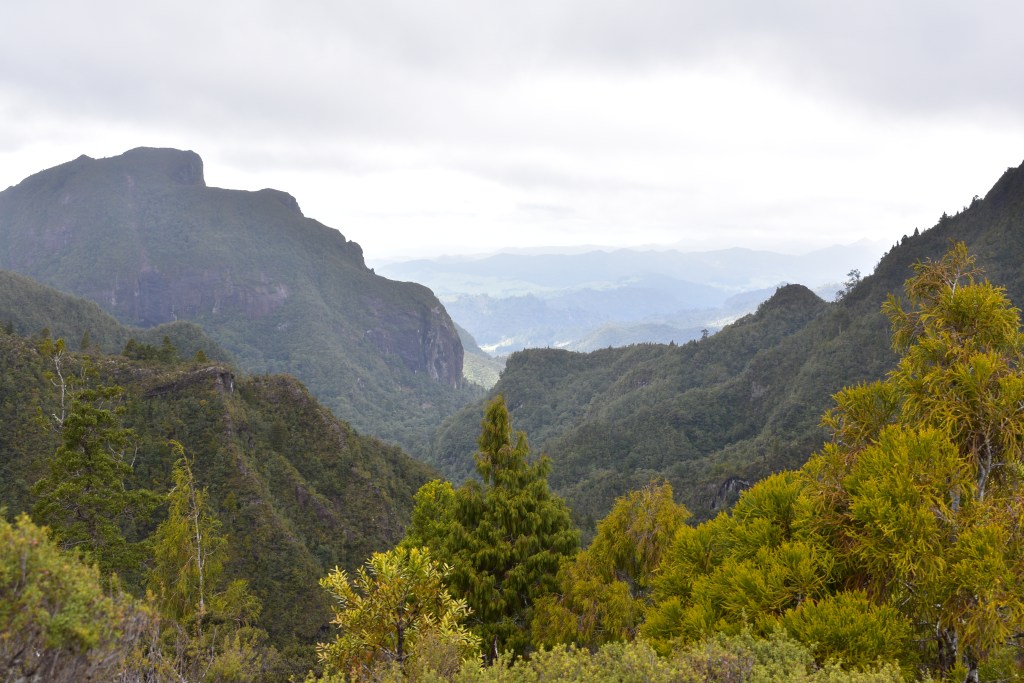

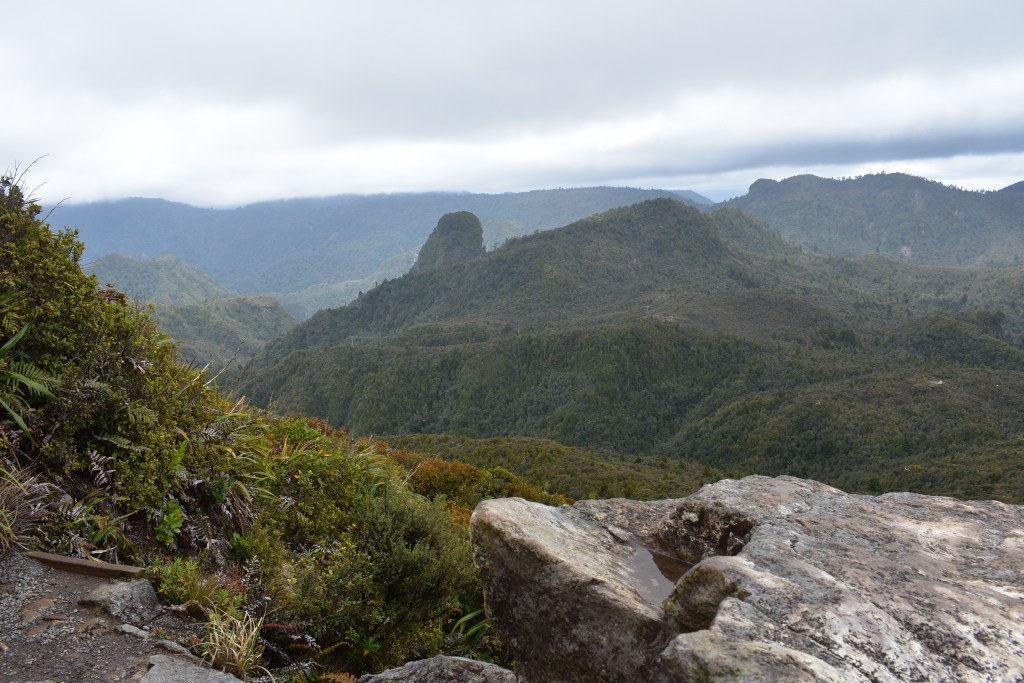
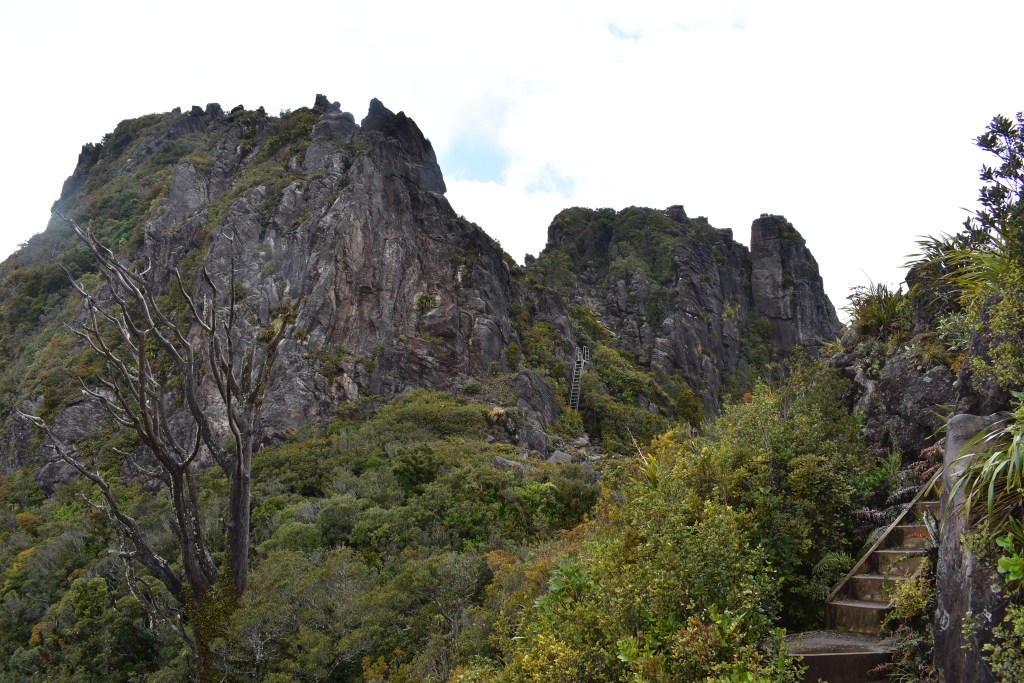


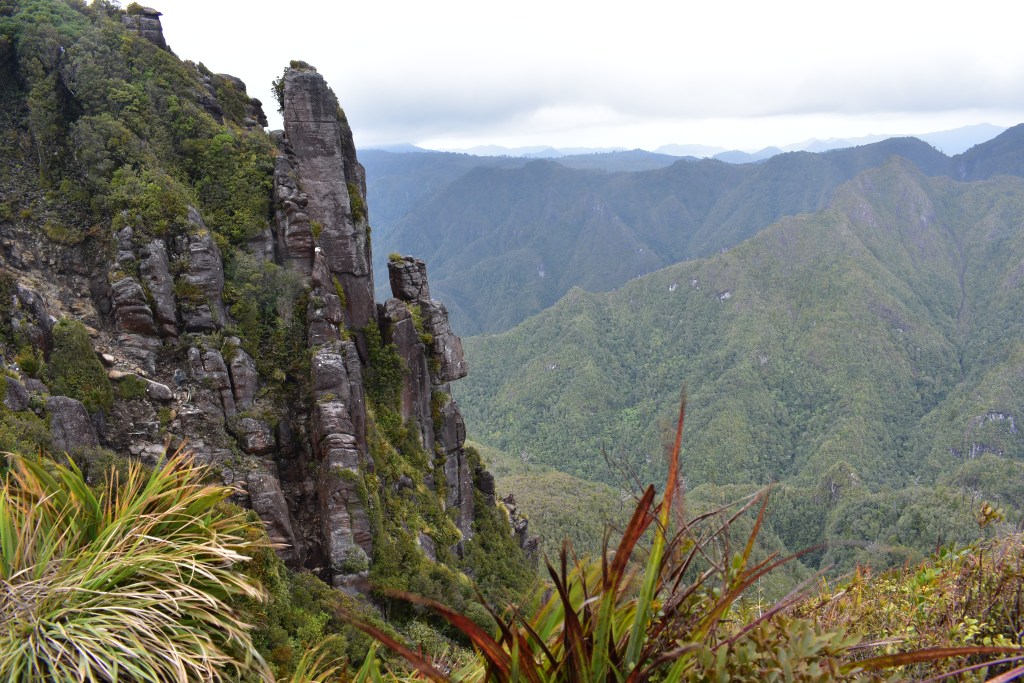
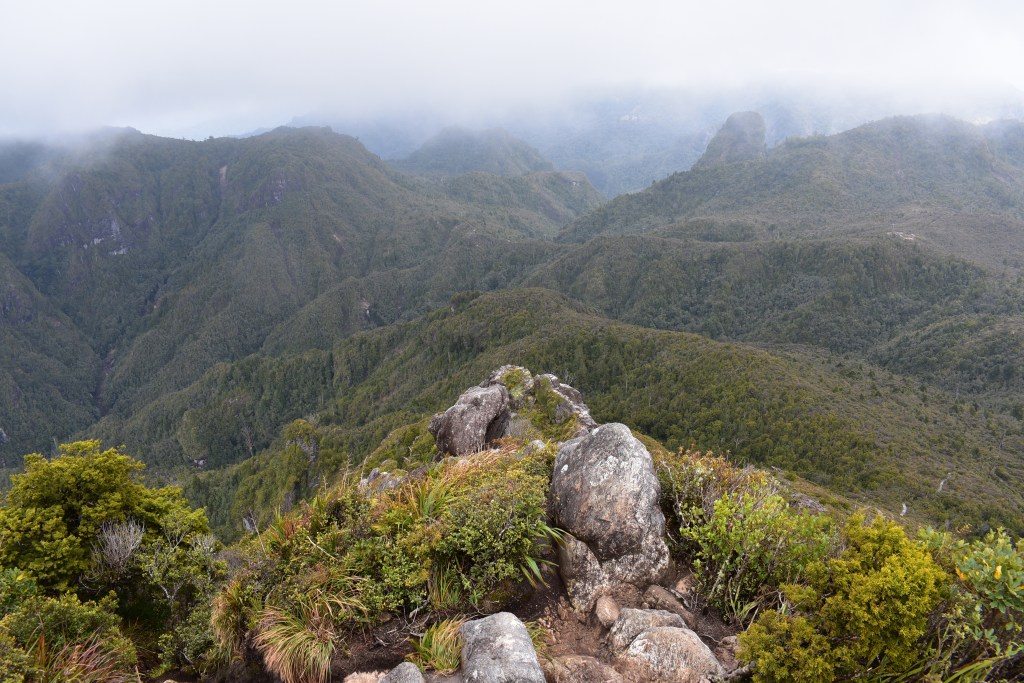
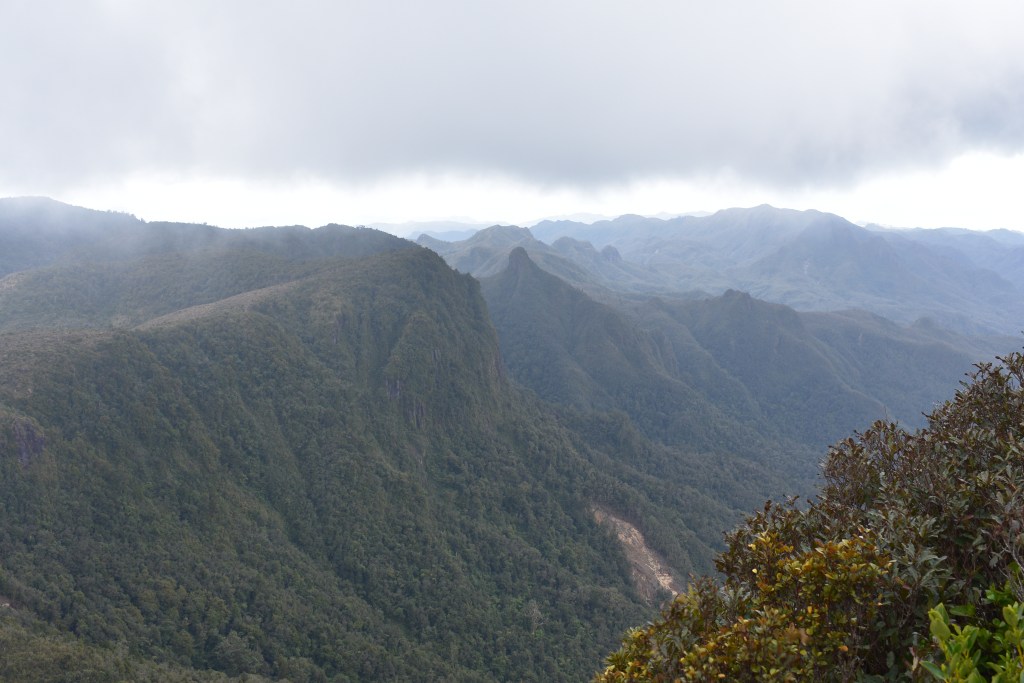
I got back to the Visitor Centre just as Donna was closing as wanted to see her before she left. I had signed into their visitor book thinking that being on my own and in the eventuality that I didn’t return, a search party would be sent looking for me. But this wasn’t the case. I’m sure, however, that if anything had happened another walker would have found me. I certainly couldn’t have got a signal to call emergency 111 should I, or anyone else, have been in trouble. There was a small helicopter landing pad along the route which was comforting. Donna was in no hurry to close and gave me a big hug which was sweet of her. I must mention, at this juncture, how genuinely kind and interested most of the Kiwis I’ve met have been.
I was feeling quite exhausted, red in the face and sweaty from all the exertion but was so happy to have managed the walk. I paid a visit to the Pak ‘n’ Save supermarket, topped up with petrol (someone had previously told me Thames was the last place for petrol before heading north which turned out not to be true!) and drove to Coromandel Town for my next stop, a distance of 54km which took an hour. This was a lovely journey which wound round and round the hillside hugging the shore for most of the way, rising steeply at one point for a great lookout stop, then back down to the shoreline.
Views en route to Coromandel Town:
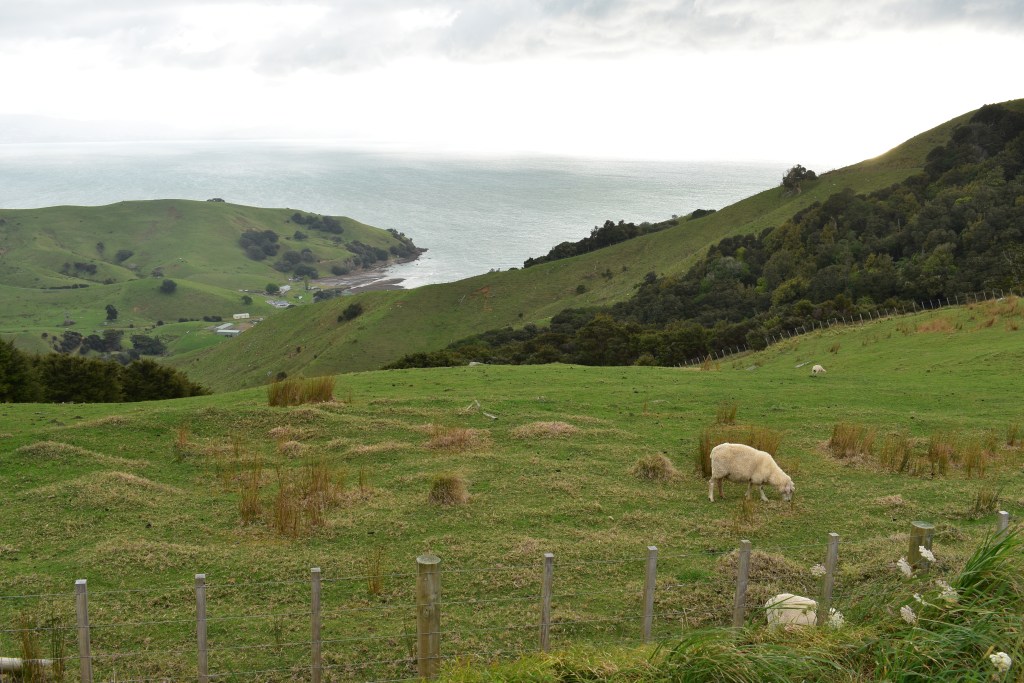
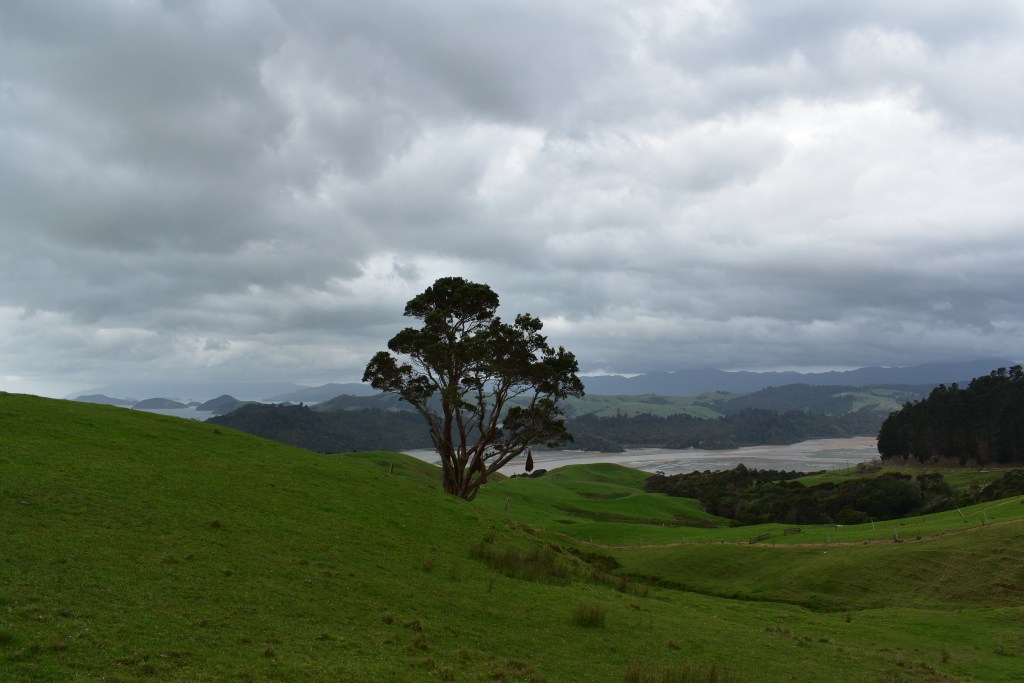
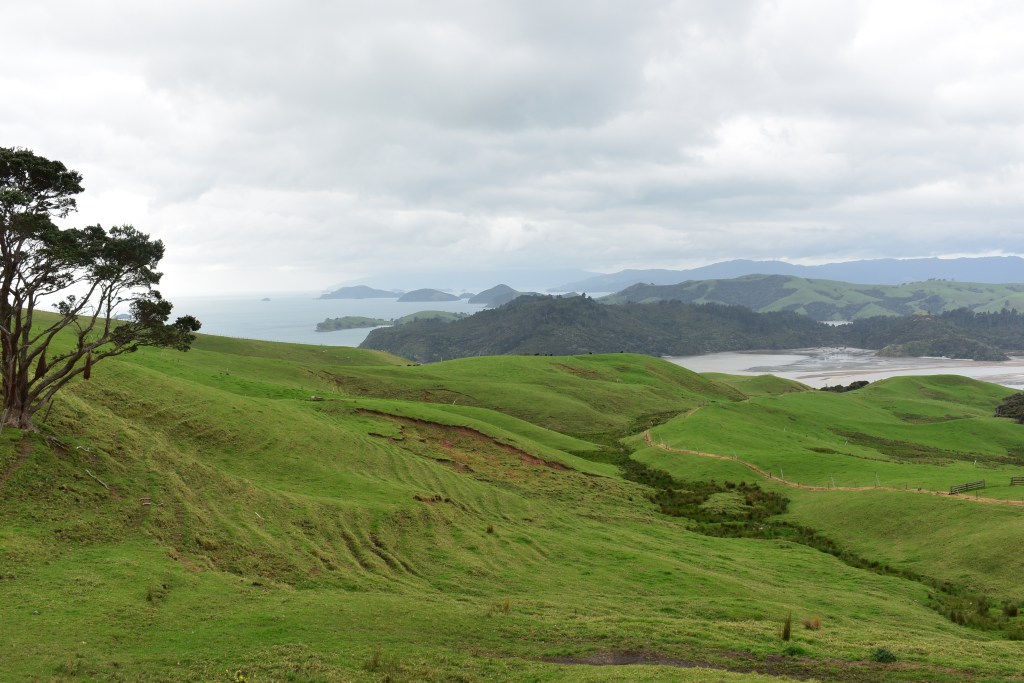
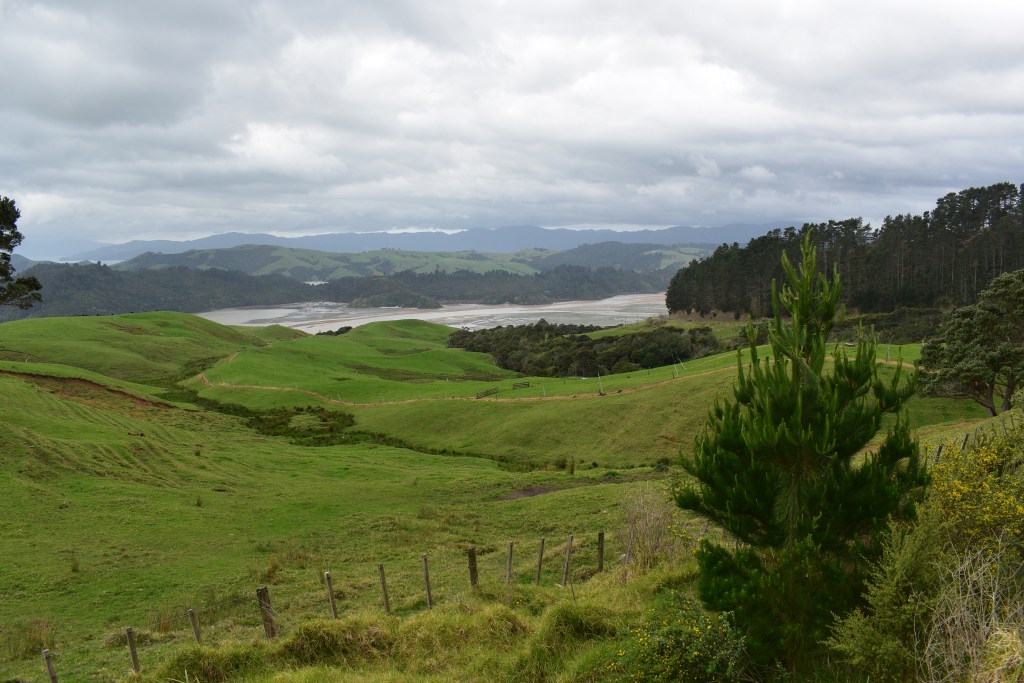
Some information about the Coromandel Peninsula. This area just into the Pacific, east of Auckland, forming the eastern boundary of the Hauraki Gulf. It has a dramatic mountainous spine which bisects it into two very distinct parts. The east coast has some of the North Island’s best white-sand beaches and is a favourite area for Aucklanders to head to for Christmas. The Maori tribes in this area were some of the first to be exposed to European traders. Kauri logging was big business and shipbuilding took off in 1832 but things got tough when kauri around the coast became scarce and loggers were forced to penetrate deeper into the bush for timber. By the 1930s virtually no kauri remained and the industry died.
My Airbnb host in Coromandel Town was Jeff, originally from Lancashire. He’d offered to cook dinner one night for $25 and suggested scallops which I accepted and had decided tonight would be a good night as I knew I’d be tired and wouldn’t have to think about where to eat. He’d messaged me earlier to say another lady guest would join us for dinner. The address was 162 Watt Street and the street seemed to start with no. 56, then there was no.68, 76 then a big gap before 162, although I drove along the street several times before I found it! When I eventually arrived at the house it seemed there was a small party going on with Jeff and three other women all drinking wine while they were waiting for me. When I asked why there were so many house numbers missing Jeff, who is stone deaf so lip reads, explained that the number of the houses are the distance in meters from the start of the road so his is no. 162 as it’s 162 meters along! I thought this rather bizarre.
I gratefully accepted a glass of wine and was glad that I’d bought a bottle to share too. The other women were Cynthia (other Airbnb guest) a Kiwi from Auckland who had decided she needed a short break from her very needy four grown up children, husband and family business. Despite the close proximity to Auckland she’d never been to Coromandel. She told me later in private that she’d thought it rather unusual when Jeff had offered to cook dinner. She’s a nice lady and easy to talk to. Another woman was Johanna aged 81 (although you’d never have known) who travelled to Australia as a £10 Pom in 1963 with a friend. She later met her future husband in Oz (also from the UK), married and moved to NZ buying a farm and having two children. They had moved to Coromandel Town after selling the farm two years previously but just a few weeks later her husband had a brain haemorrhage and died. She was quite matter of fact about it all and had met Jeff when they were both walking their dogs on the beach, purely a platonic relationship. The other female was a young German girl called Saskia who has been renting a converted shed from Jeff for two years and works at the Dawson Creek Railway on a soon to be opened zip wire.
Jeff told me that his father had been a violent alcoholic so he’d left home at the age of 16. He joined the SAS when he was 28, did lots of tours of duty and on one of them, when he was 38, an explosion had left him completely deaf and ripped open his head. It was quite hard work talking to him with this deafness and it made me think just how lonely it must be at times. He later told me he was quite content in his own little world. I’ve no idea how old he is but would guess early to mid 60s. He cooked a lovely risotto and scallops in a pesto sauce. Much wine was drunk, which possibly wasn’t a great idea after my walk, and it was an enjoyable evening. Jeff has two lovely Collie dogs, Laurel and Hardy, who are brothers aged two.
I had booked to go on ‘Driving Creek Railway’ on Friday, a recommendation from someone. Jeff presented me with a lovely breakfast of his home made muesli, wholemeal toast with a variety of jams and marmalade, and cakes. He owns a tourist attraction called Waterworks, just out of town, which is apparently fun.
The railway was along Driving Creek Road, hence the name, not very far out of town. I’d booked for 1130 and was one of 16 with a driver called Russell. This was an amazing narrow gauge railway which had been built over a period of 30 years by one man called Barry Bickell, a potter. He had arrived in Coromandel from Auckland in 1961 and became NZ’s first kiwi-born full-time handcraft potter. Having bought the land he originally built the railway for himself in order to access some clay up the hill for his pots. People became interested in it and he realised it could be a viable tourist attraction first opening to the public in 1990 after which he continued extending the track. He died 3 years ago aged 80 of cancer and was buried up the hill by the railway, permission for which meant he’d had to jump through some bureaucratic hoops. He left the railway in a Trust before he died.
The whole journey was an hour long and climbed up by means of switchbacks on about 5 occasions. It was quite some feat and to think Barry had built the whole thing completely on his own. He’d also planted thousands of native trees including Kouri, Rimu and Rewarewa since 1973 in the area. The train went to the Eyefull Tower (pun but also because you get an ‘eyefull’ of views) with a viewing platform. Along the way were various terracotta sculptures and a large wood carving.
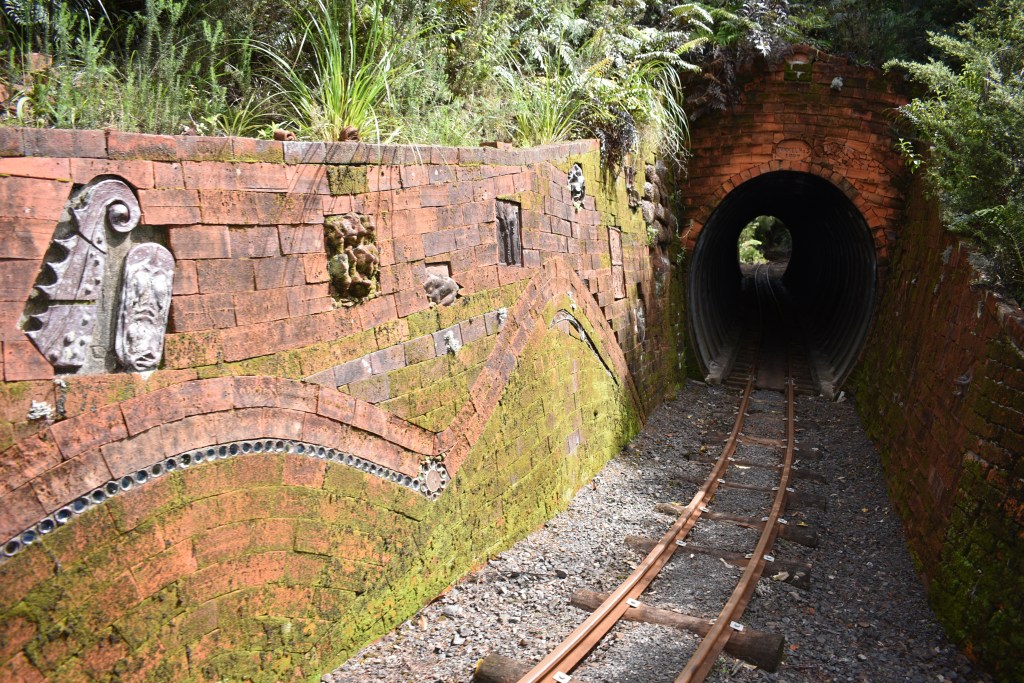
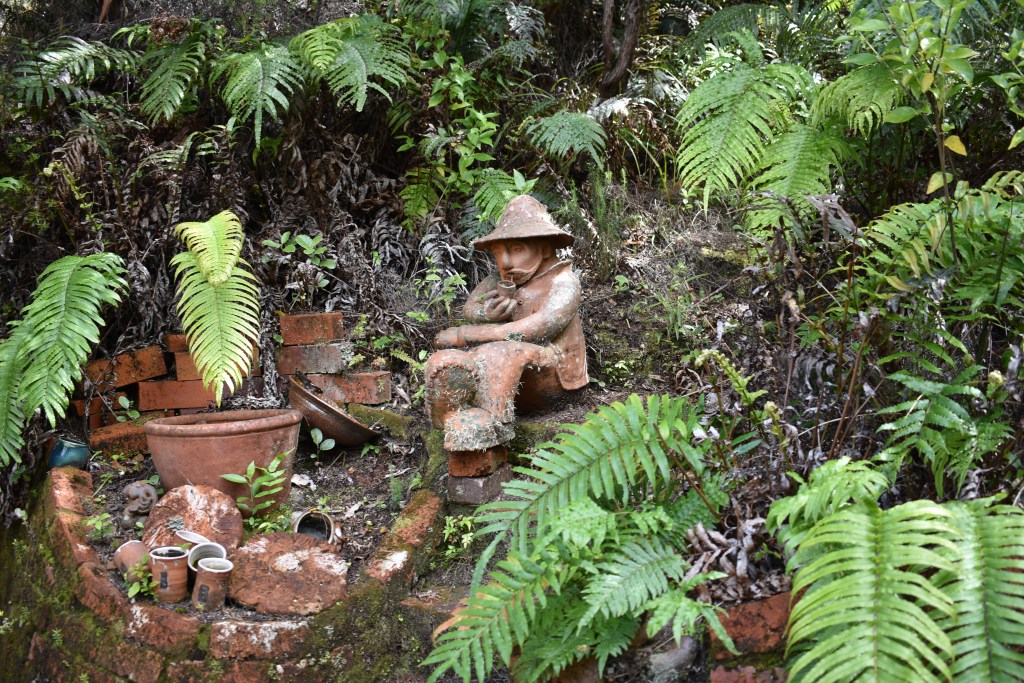
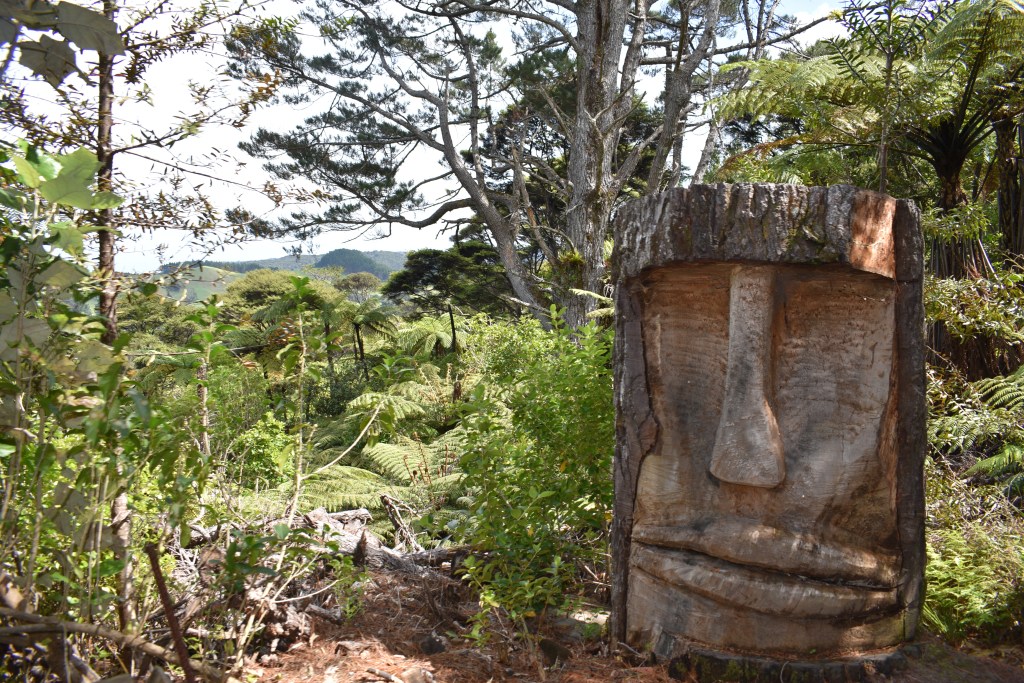
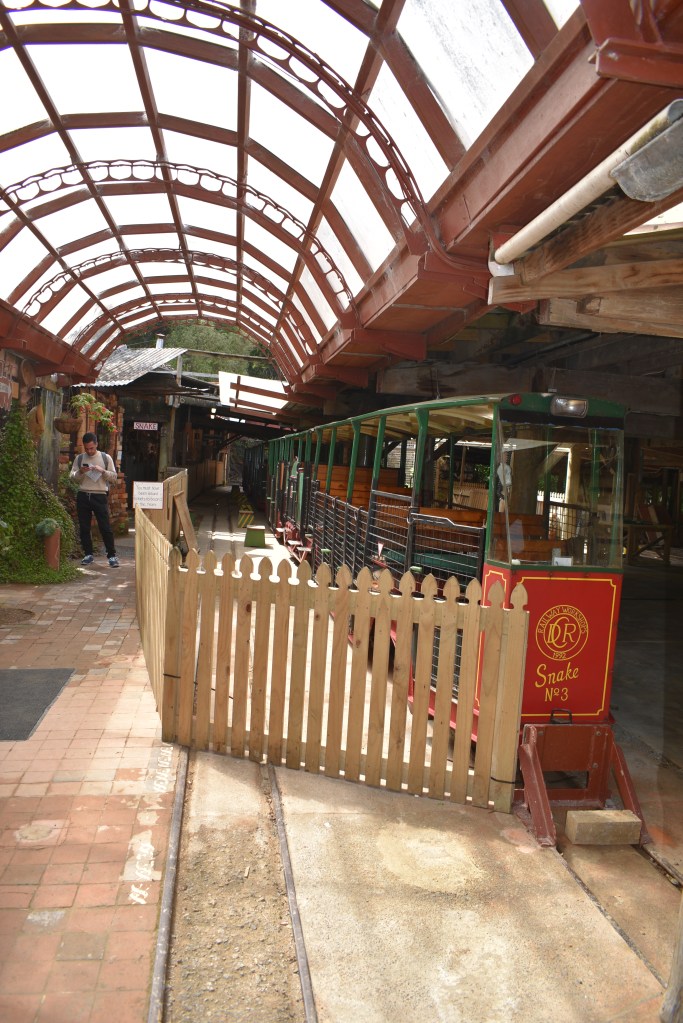
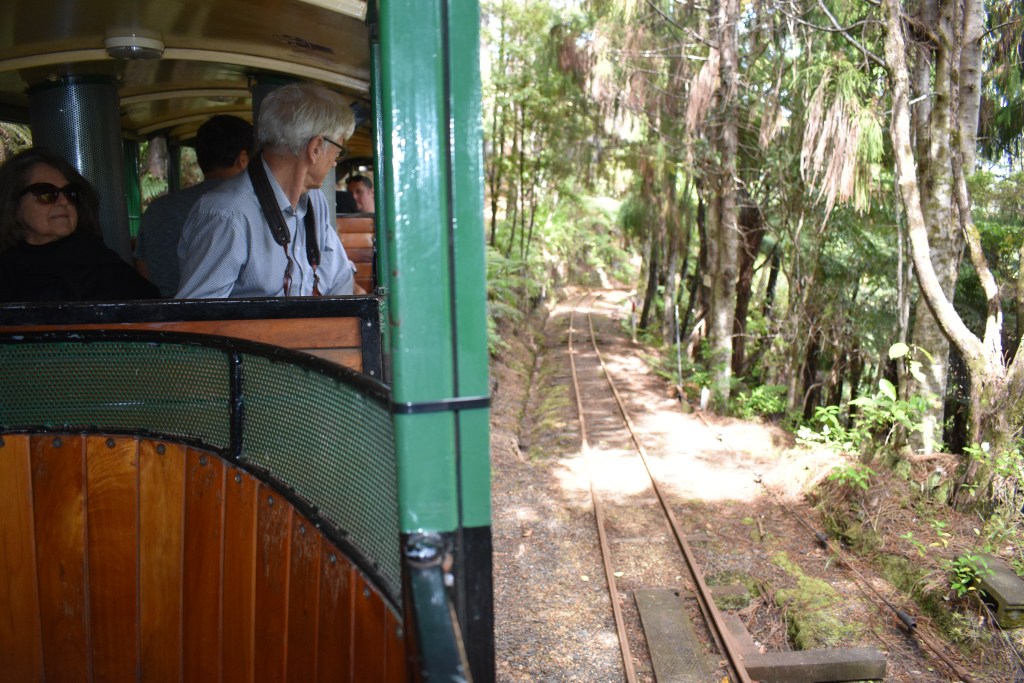

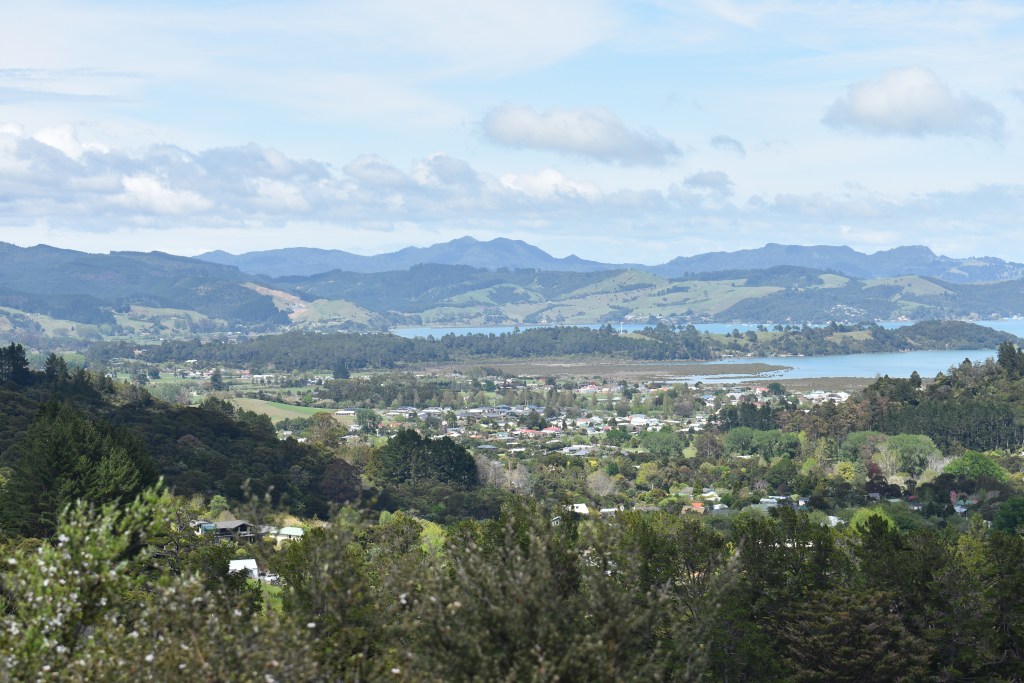

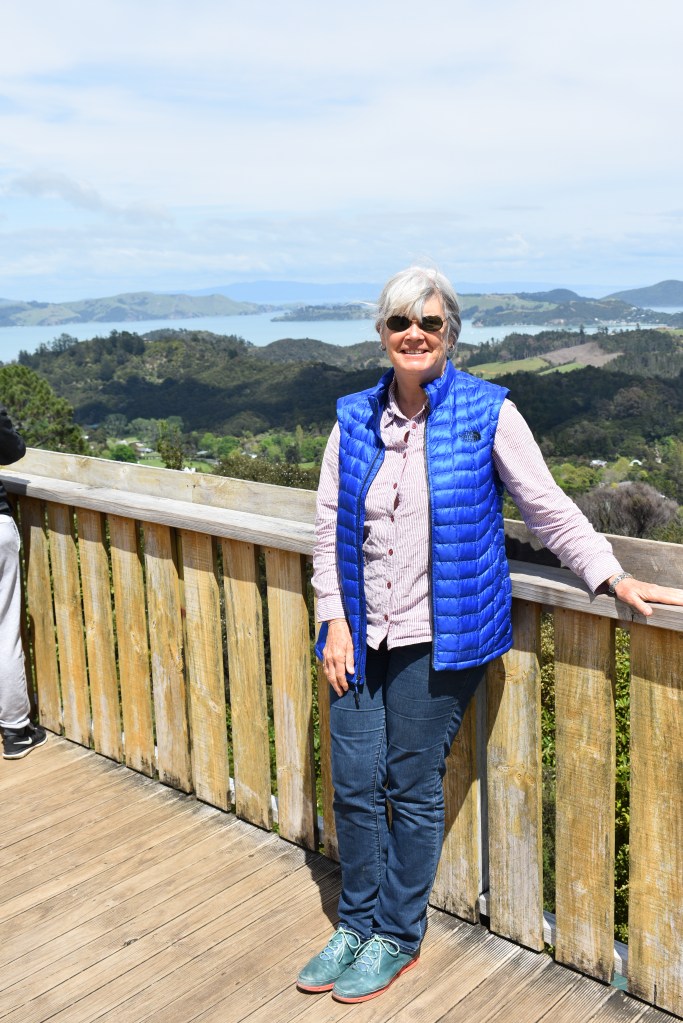
On the EyeFull Tower 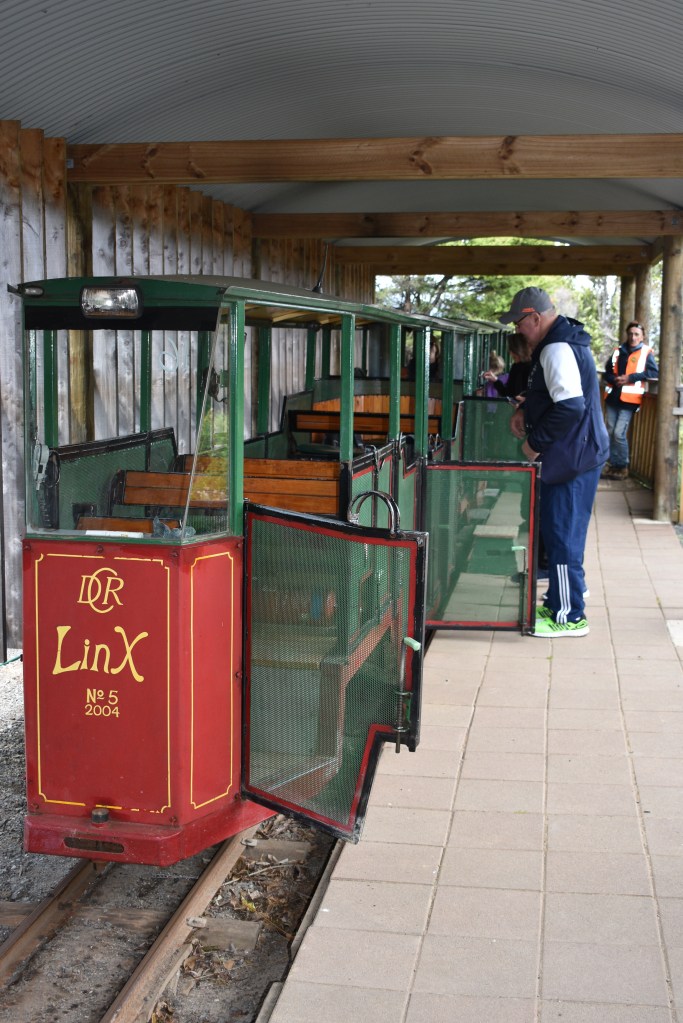
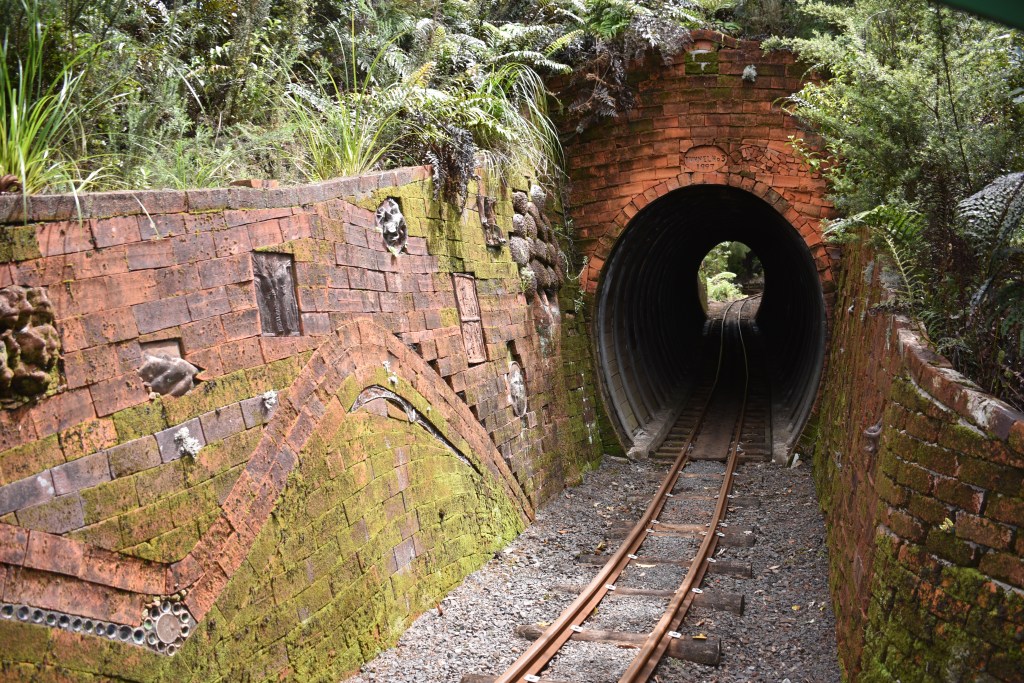

Building the railway from scratch had required the daunting task of surveying a route through the very rough countryside. Trial surveys were made with a hand slasher and home-made surveying instruments, a process which had to be repeated until a suitably graded route could be found. Most of the track was built by hand by Barry and local contractors brought in to help with major earthworks. There are bridges/viaducts, three short tunnels, two spirals and five reversing points to gain elevation to EyeFull Tower. There are studios and accommodation for resident and visiting potters from NZ and all over the world. Currently zip wires are being finished and will open shortly so people can have the choice of going up by train and return by zip wire. They’re also in the process of establishing a NZ Ceramic Heritage Museum.
After this lovely trip I drove a short distance along the coast road to Long Bay where I had a picnic lunch and then into town to wander around the few shops. There were some lovely arty pieces but I can merely view and not buy, unfortunately or maybe it’s fortunate. It was a lovely warm day but by this time I was feeling extremely weary and decided to go back to the house for a cup of tea and afternoon nap. I just snacked for dinner as couldn’t be bothered to go out to eat.
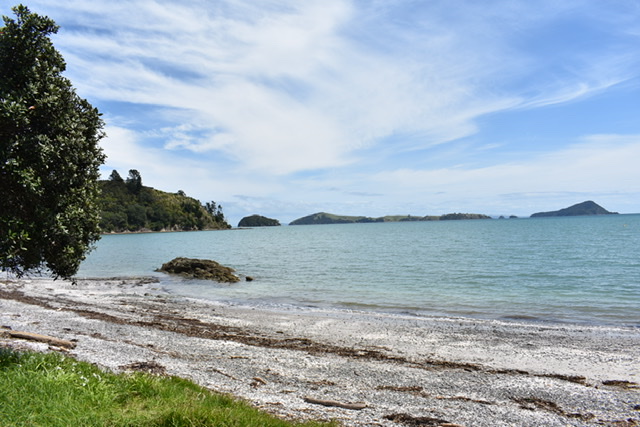
I met up with Gerry, Johanna and their 24 year old daughter Lotti at 9am for our trip to the Coastal Walkway in the north of the Coromandel Peninsula and discovered they’d been staying in their camper van at Long Bay. It was good to see them again also to meet Lotti who has been studying for a PhD at Auckland University for the past 2 years, researching a cure for Motor Neurone Disease, her first degree having been in Neuroscience.
Our driver and guide was David, who was very proud of his Maori heritage. He told us he also had French blood. He was extremely enthusiastic right from the off. We were driven in a minibus with seats for 9 passengers so could spread ourselves out. We travelled along the west coast from Coromandel Town and he pointed out a beach whose Maori name meant ‘chucking away the flesh’ because the tribe that had lived in the area would eat their enemies and chuck away the flesh they didn’t want onto the beach! Another beach was called Papa Aroha, meaning ‘Beach of Love’. We stopped at Colville, a very small town whose original name meant ‘Cabbage Bay’, which I’d heard was a bit alternative. We visited their only store which had all manner of goods, not just food but also souvenirs, tools, items for cyclists and motorists – it was quite an Aladdin’s Cave but I left without buying anything.
We passed an area called Freeman’s Bay which David told us was owned by the lead singer of Fine Young Cannibals, then he pointed out an area where there was a commune. The commune couldn’t be seen from the road and I thought how much I’d hate a) living in a commune and b) being so far from civilisation! David had told us that for years he’s worked in the bush, conserving the environment. He currently works for a private company called the Moehau Environment Group (meg.org.nz) and stopped at a sign overlooking thick forest, just part of the area that he works in, giving information about their work. Part of David’s work is to clear paths and set traps to catch stoats, rats and possums, all predators of the Kiwi which had been losing lots of numbers although their work means they’re slowly increasing.
The journey from then on was on unsealed road which I certainly wouldn’t have wanted to drive a car on but the minibus took it in its stride. David stopped at a very upmarket hotel, the Tangiaro Kiwi Retreat, which people sometimes helicopter in to from Auckland and use as a venue for weddings. It was certainly in the middle of nowhere.
A lot of the land we passed through had been owned by families ever since the first colonials arrived, such as families Ward and Evans. David said that they commanded a lot of respect. He did touch on the Maori current grievances for land that they felt they should be paid for that was taken from them in the 19th century. He also pointed out a couple of leaves that were used for remedies such as the Kowa Kowa, a heart shaped leaf, which when made into a tea is good for blood cleansing and when used as a steam bath clears the nasal passages. He promised us a taste.
By 1130 we had arrived at the drop off point for the start of our coastal walk, Stony Bay past Port Charles. David told us the walk north west to Fletcher Bay generally takes 3-3 1/2 hours but he gave us 4, arranging to meet him at 1530. Before we set off he recited the Lord’s Prayer in Maori (although he’d previously told us he didn’t know a lot of the language) which is apparently a tradition before an event – it was very moving and we all remained quite still and solemn.
The walk certainly wasn’t as hard as the Pinnacles, although my legs still hadn’t recovered from that, but there were a few steep sections. We went through forest initially, opening up to an amazing lookout where the sun burst through the clouds, the journey having started off a bit drizzly. We stopped at another lovely viewpoint for our packed lunches and a bit later on when the walk went across fields. We ended up arriving at Fletcher Bay, where David was patiently waiting, at 4pm. I’d enjoyed chatting to the family who are all very easy to get along with and was glad I’d had their company again.
David then drove us a bit further along so we could walk to Muriwai Beach, quite steeply uphill, along a ridge, down a lot of steps then across the beach taking us 50 minutes. When we met up with David again he made us normal tea and also passed around some Kowa Kowa tea which was quite minty and not unpleasant.
Back in the minibus along an unsealed road down the west coast, with a couple of stops for photos, and back to Coromandel arriving at 7.30pm. Before leaving us David said another prayer in Maori.
By this time we were all quite hungry and selected a restaurant which looked mediocre from the outside but turned up some excellent food. I had the most delicious bowl of chilli seafood with stir fried vegetables. I said goodbye to the family feeling that I’d made some new friends with whom I would love to meet up again either in Southern Ireland where they live or in England but probably never will.
A few pics from today’s lovely coastal walk (not sure why 3 have turned sideways!):
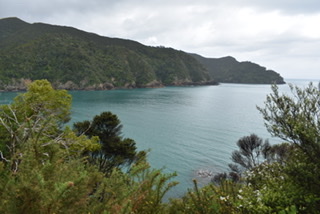
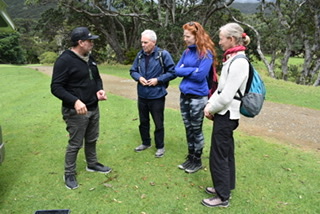
David, Gerry, Lotti & Johanna 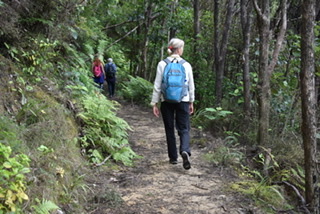
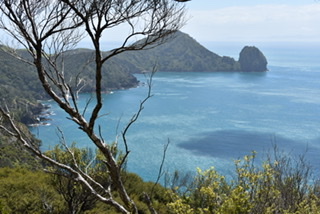
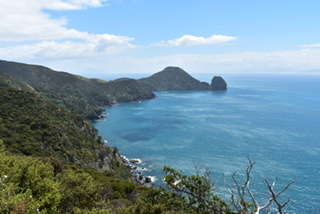
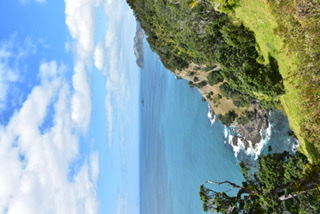
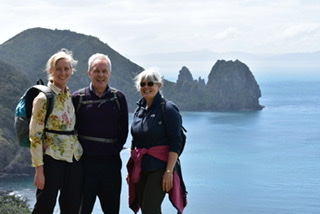
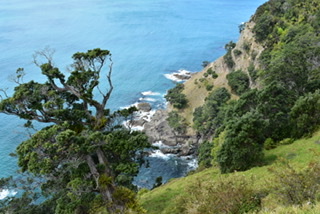

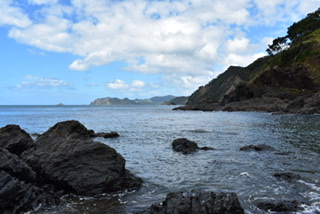


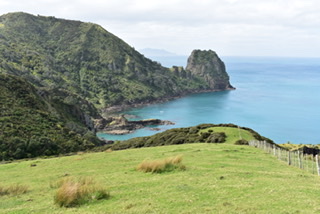

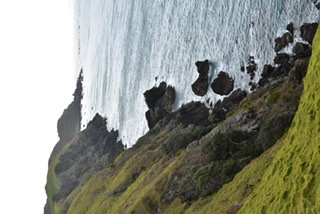

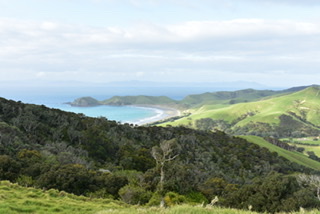
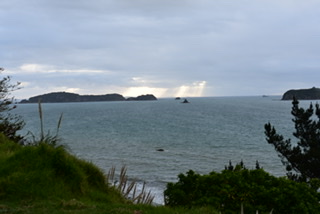
Sunday was another lovely day. I had an early breakfast, partly joined by a young couple who’d stayed for 2 nights – she a Scottish Doctor and he an English town planner who’d been working in Wellington for nearly 2 years and were looking forward to going home for good in December.
I left at 0930 saying goodbye to Jeff and Cynthia and decided to do a driving tour stopping off as I fancied en route to my next stay. The driving is just fabulous, winding round and round, of course the locals bomb along far too fast, I think, especially as the road is narrow with rarely a barrier on the drop side. Not surprisingly the Coromandel Peninsula is a favourite area for motor cyclists to ride. I stopped first of all not too far from Coromandel Town at a lookout point and took a picture:

I then drove to Whangapoua from where it was a short walk to New Chums Beach, a recommended place and seemingly voted one of the world’s top 10 beaches and 60th of the 101 Must Dos for kiwis. It is a protected beach with no buildings or infrastructure. Accessing the beach means crossing a stream which, from watching other people, was knee deep and then a 30-40 minute walk around the headland. I decided not to bother as was worried about slipping and dropping my camera!!! I checked out the pictures of it online afterwards though! Here’s one:
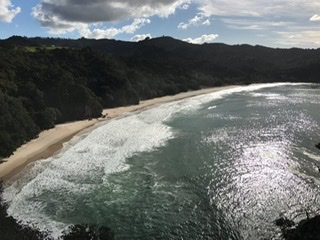
I stopped at a place called Kuaotunu and had lunch at cafe ‘Luke’s Kitchen’ which was busy with some people having pizza outside enjoying the sunshine. On I drove, stopping again and was beckoned by a cyclist who pointed out a pod of dolphins. By the time I got my camera out they’d virtually gone, sadly, but it was a wonderful sight and hopefully there will be more such sightings with camera at the ready.
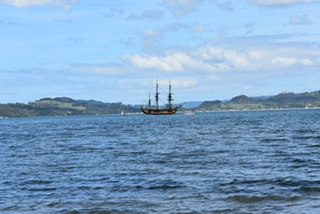
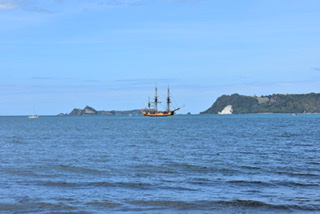
I drove to Whitianga mainly because I’d been told a replica of the Endeavour was there as it’s 250 years since James Cook first landed in NZ and along this east side of the Coromandel. I hadn’t wanted to stop originally because I’ve a housesit coming up there in November so wanted to save looking round for then. However, I walked to the ferry point and while there were two sailing boats they weren’t the Endeavour. Someone then told me that it could be seen from Simpsons Bay, which I had passed, but was anchored off shore. So I drove there and it was a lovely sight. I liked to imagine it was the real thing and having recently read the first book of a historical fiction trilogy about James Cook (by Graeme Lay) it wasn’t difficult:
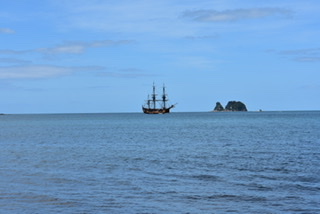
From there it was a 40 km drive to my next stop for 2 nights in Tairua, the Tairua Shores Motel, where I was greeted by a very nice young Asian man called Steven. I have to say I was very impressed with my room. It was nearly 4 pm, I felt quite weary again from the accumulation of exercise I’d done and just laid on the bed not bothering to go out for dinner.
I felt quite refreshed on Monday but didn’t rush out. The room had a microwave and stove top so I made myself some porridge for breakfast and drove to Hahei, halfway back from where I’d driven yesterday on the SH25 then a turn off right. Hahei beach is quite small but lovely, in the South Pacific, which sounds so exotic.
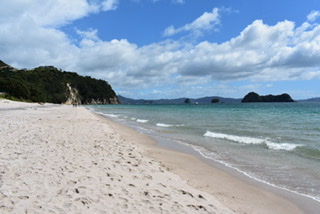
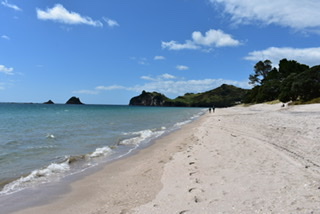
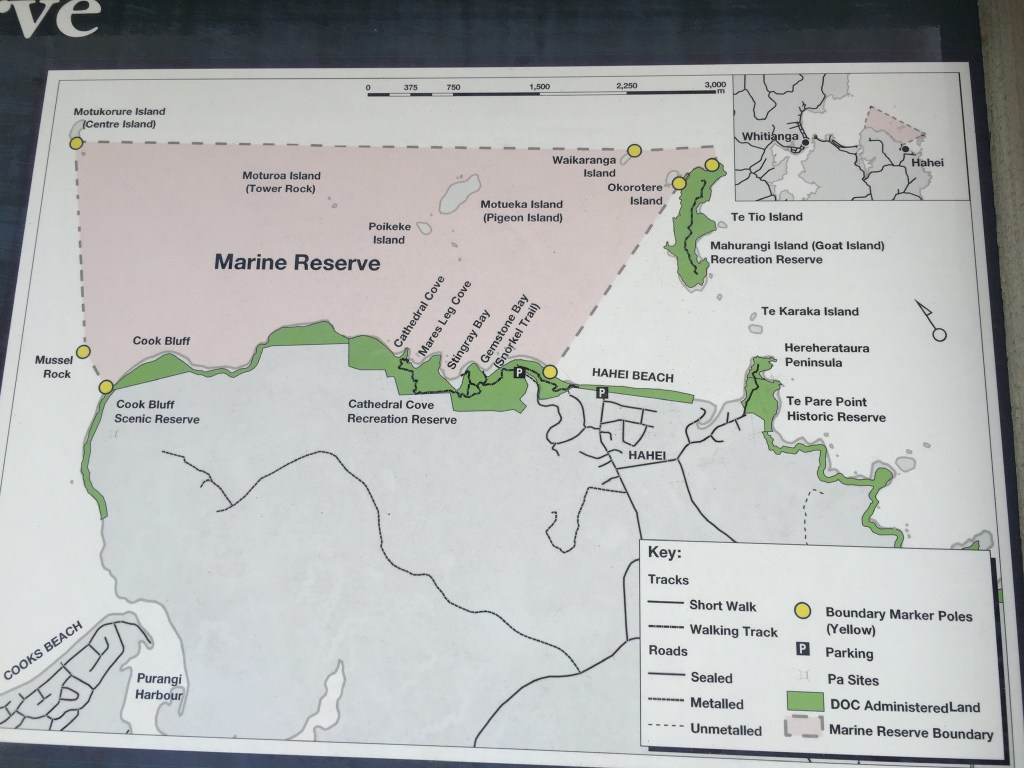
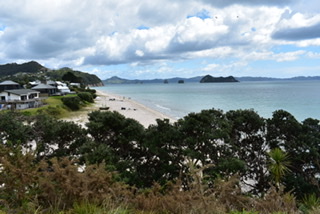
I wandered the length of the beach and decided to walk up Te Pare Point on the Hereheratura Peninsula, the hill at the southern end of the beach known locally as the Pa (Maori word for hillfort), as I could see a path meandering up. (See map above). It was well worth it for the stunning views over Hahei beach. Near the top I was surprised to see a heron.
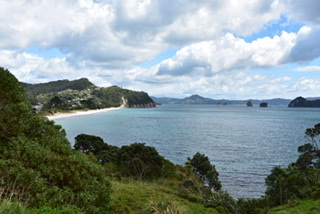
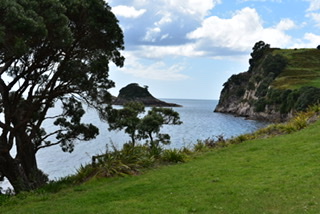
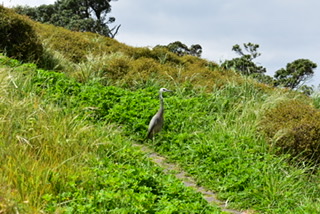
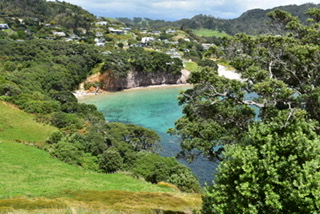
At the top I climbed onto some rocks and got a fabulous view over the other side:

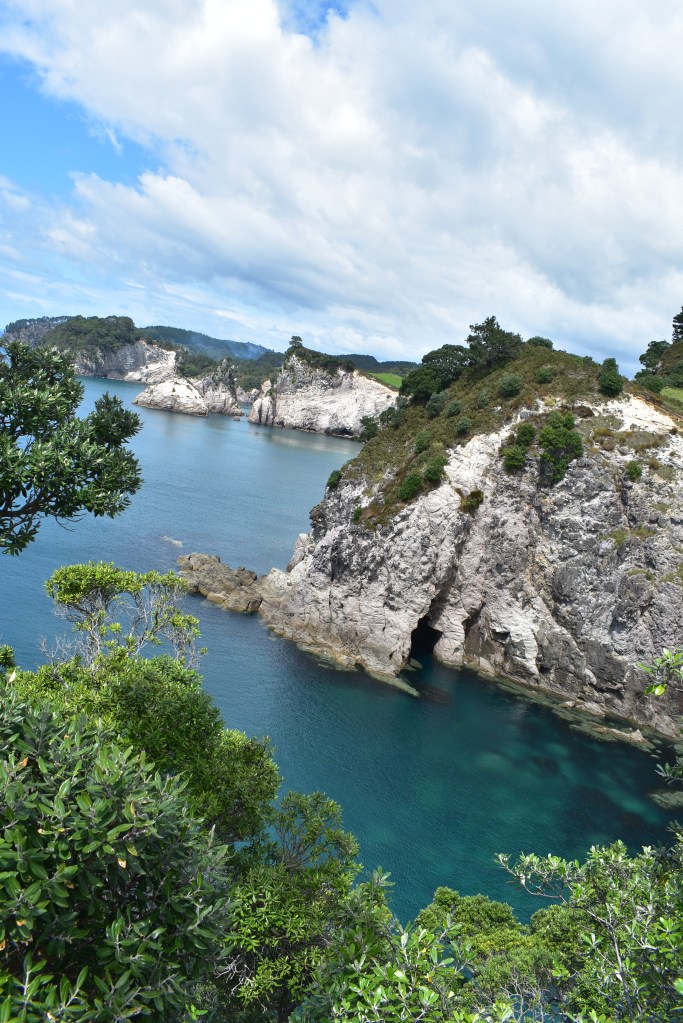
I thought it was a shame there was no one to share these gorgeous views with but then the weather changed and it started to drizzle. I was just putting my fleece on when I turned to see an Adonis walking towards me, unfortunately with his girlfriend behind. He had long swimming trunks on and a tanned, flat stomach. He looked over the edge and thought he might be able to clamber down to swim to the hole in the rock but his girlfriend told him in no uncertain terms that he wouldn’t be doing that!
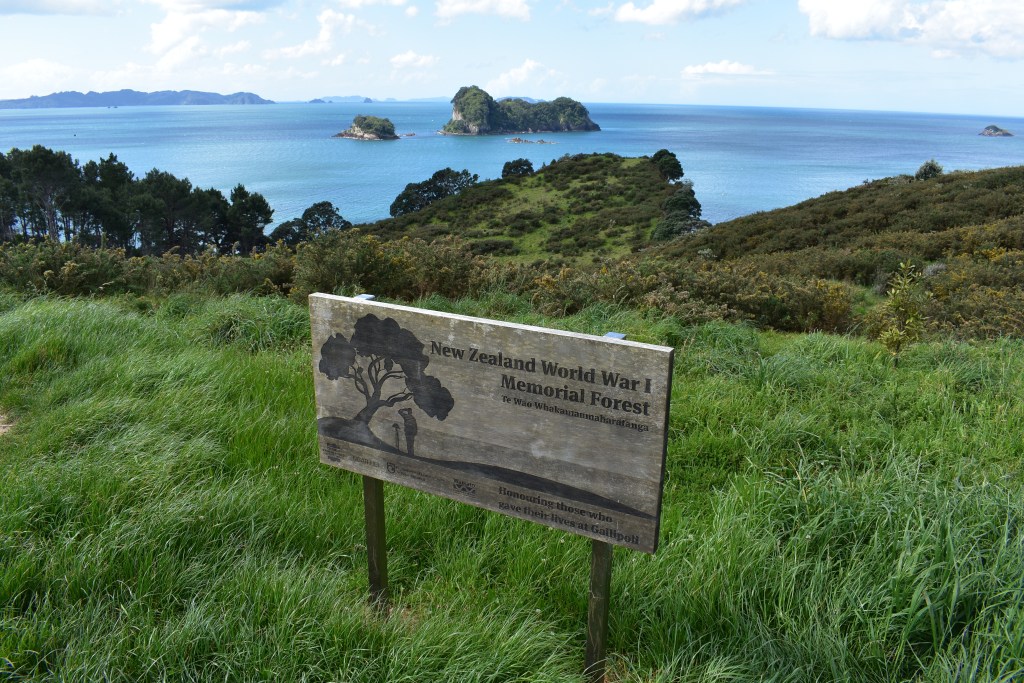
I then walked back along the beach and to the handful of shops in the little village. I had a nice chat to a man in a gift shop next door to a cafe where I’d hoped to get lunch but is closed on Mondays. I got a tea from a van turning down their menu of burgers and chips etc and walked back to the northern end of the beach to take the path to Cathedral Cove, a well known spot where boats sail to from Whitianga. I thought it would be nice to walk to it and later, during the housesit, take a boat trip there. The walk took about an hour with brief side trips down lots of steps (and back up) to Gemstone Bay (one of the best places to snorkel locally) and Stingray Bay. Just before getting to Cathedral Cove, while passing an area of forest planted in memory of those who lost their lives at Gallipoli, I bumped into Gerry, Johanna, Lotti and her Italian boyfriend Nicolas who’d joined them after our dinner on Saturday night. They were staying in campervan and tent at Hahei campsite. And there was me thinking I’d never see them again!
Some views along the walk from Hahei Beach to Cathedral Cove:

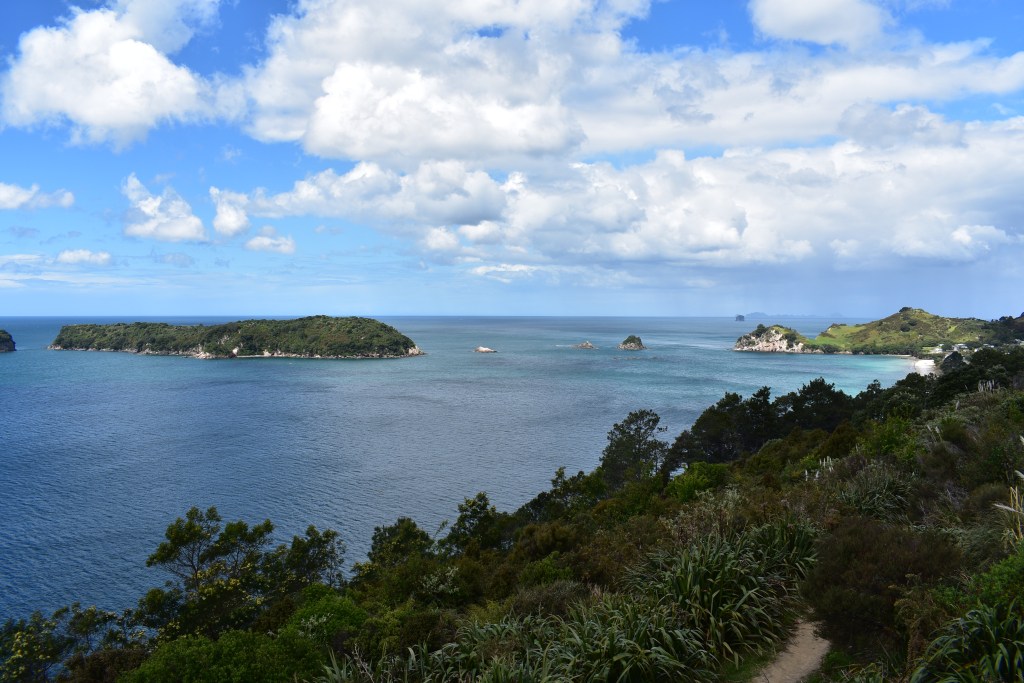

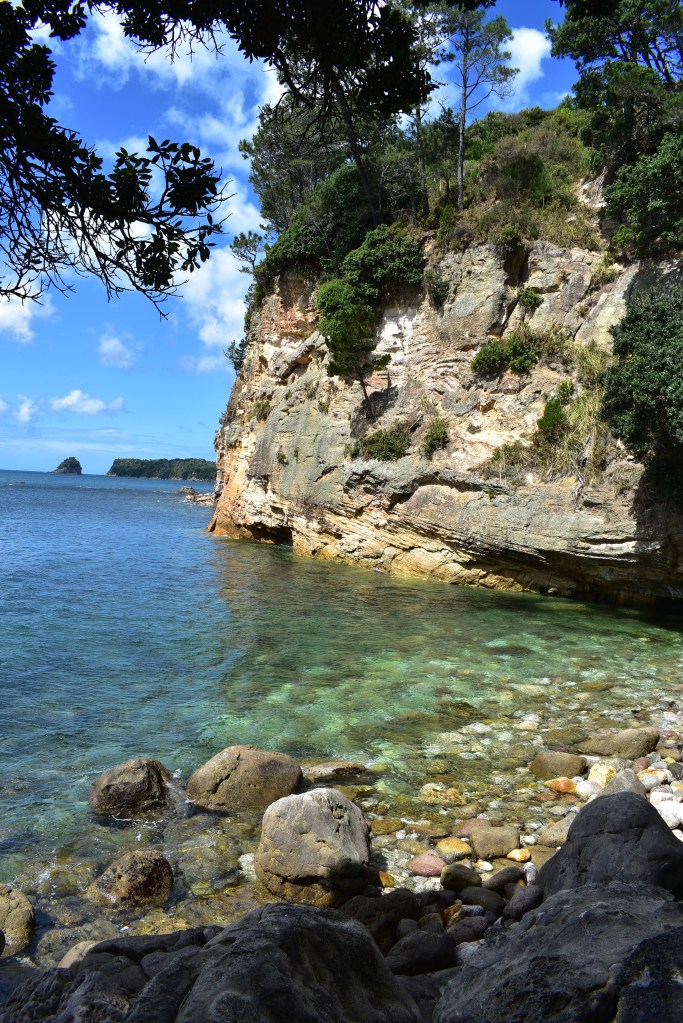
Gemstone Bay 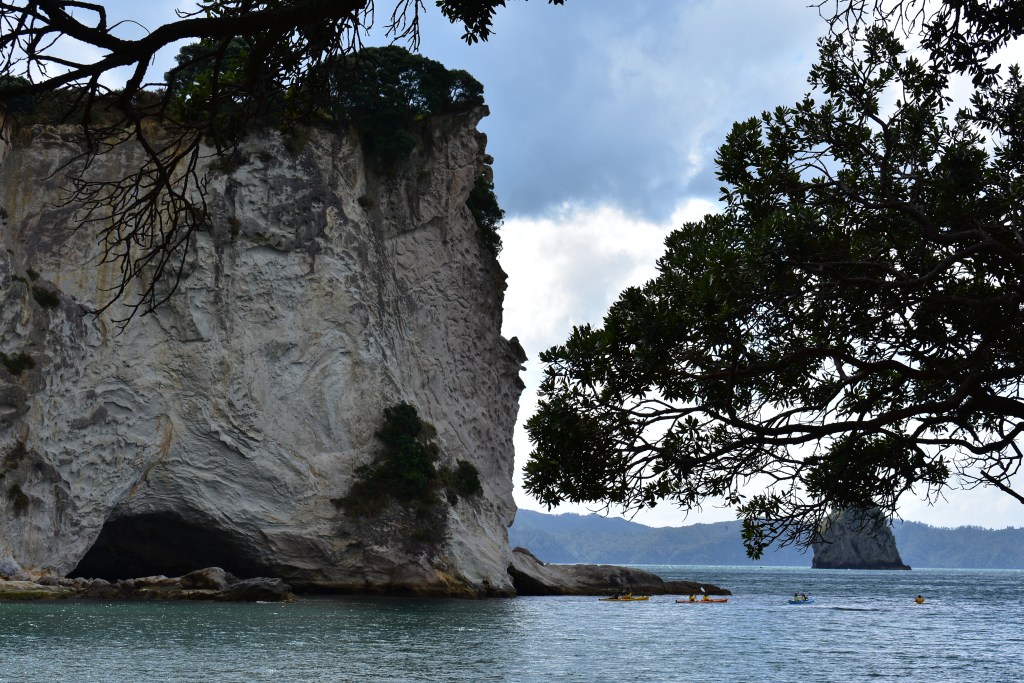
Stingray Bay 
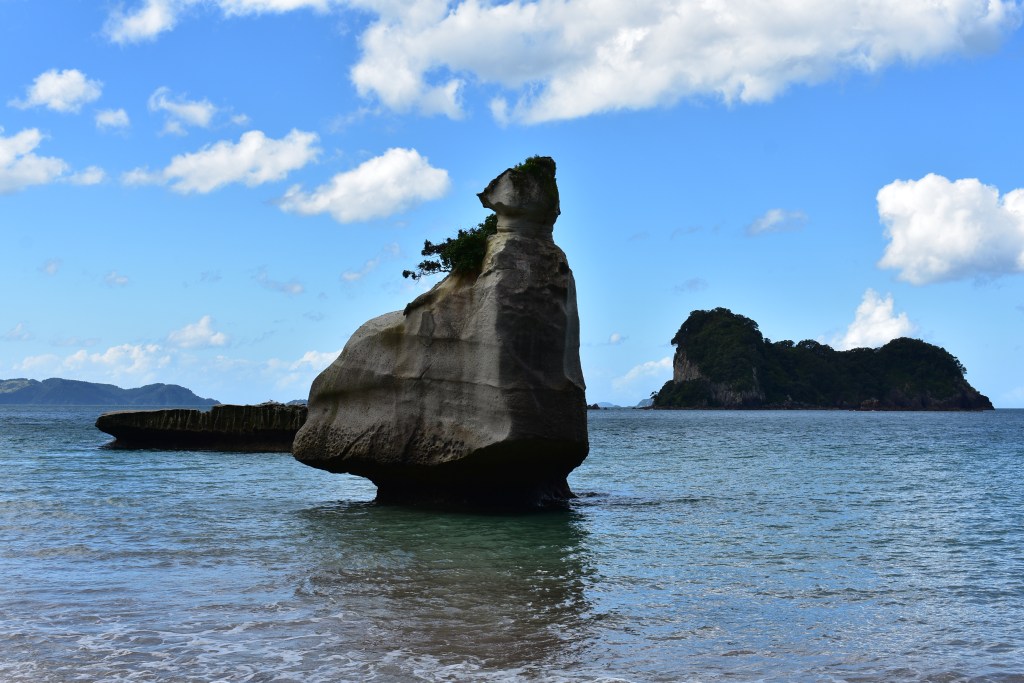
At Cathedral Cove there were quite a few people and I was very impressed with the beach and cove, it was stunning. Some kayakers I’d seen at Hahei beach were there. I was amused by a young woman who kept taking selfies, throwing back her hair and smiling into her iPhone. She must have taken at least 50 and then posed for a few more with her boyfriend who clearly had the patience of a saint.
Cathedral Cove:
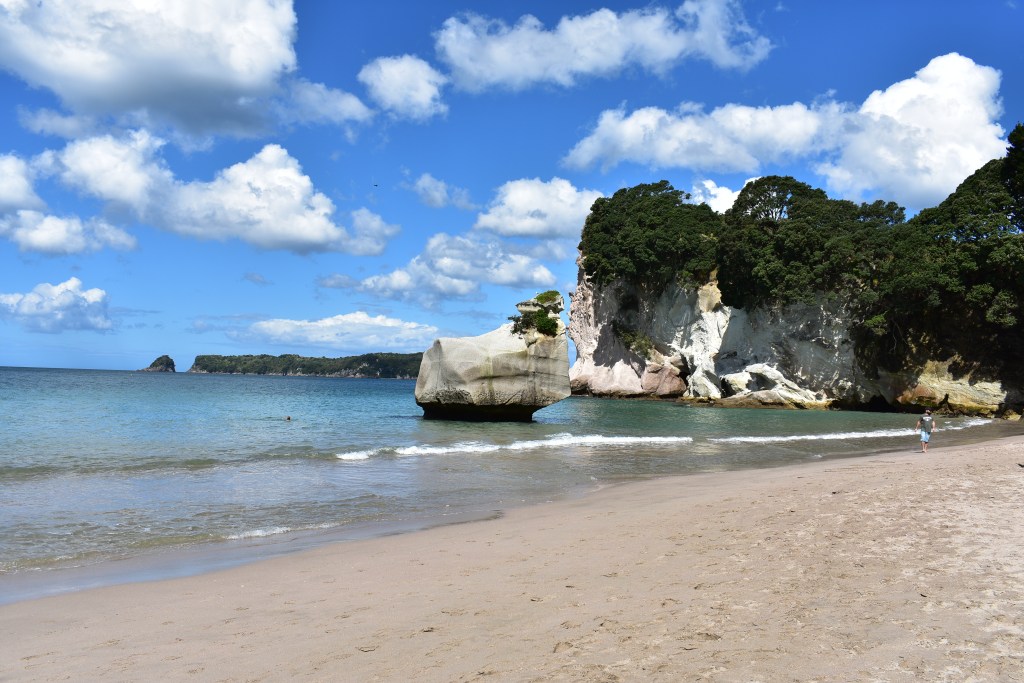
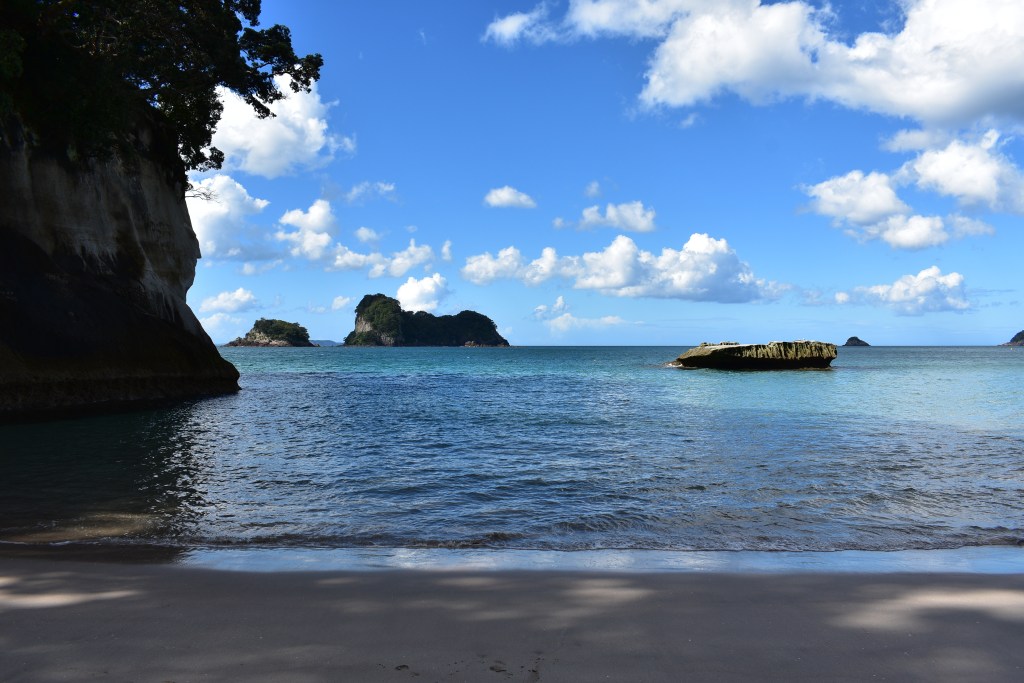
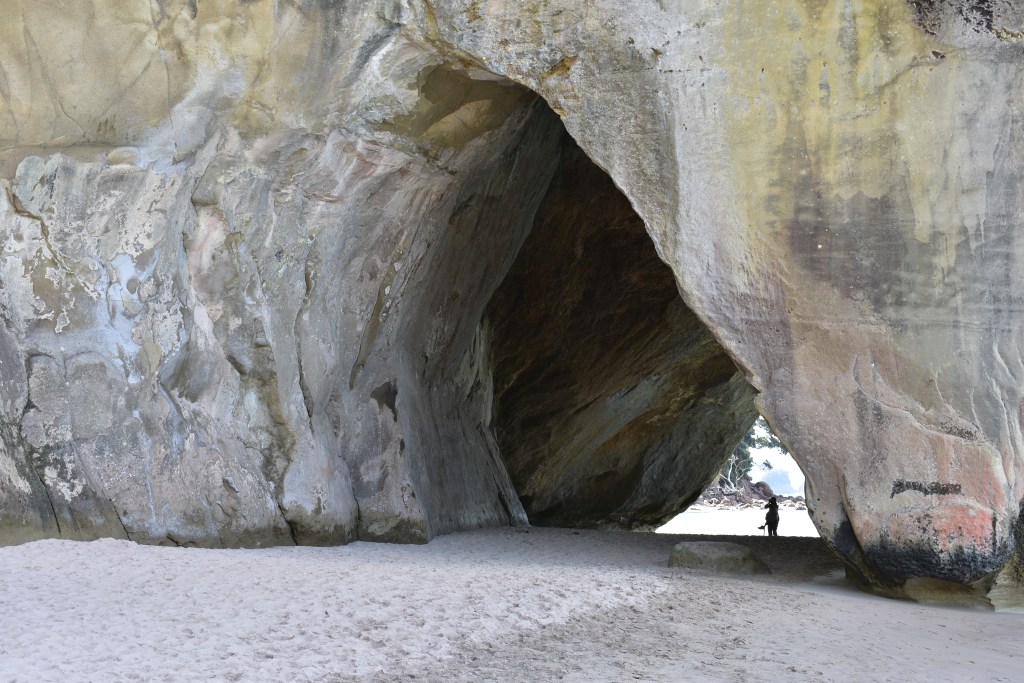
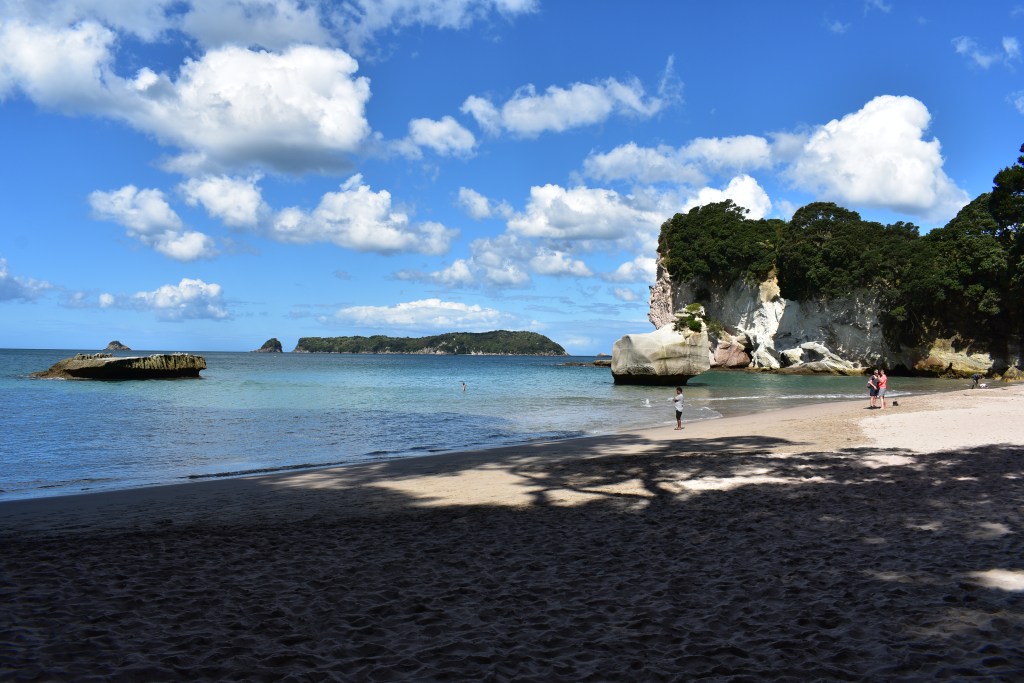


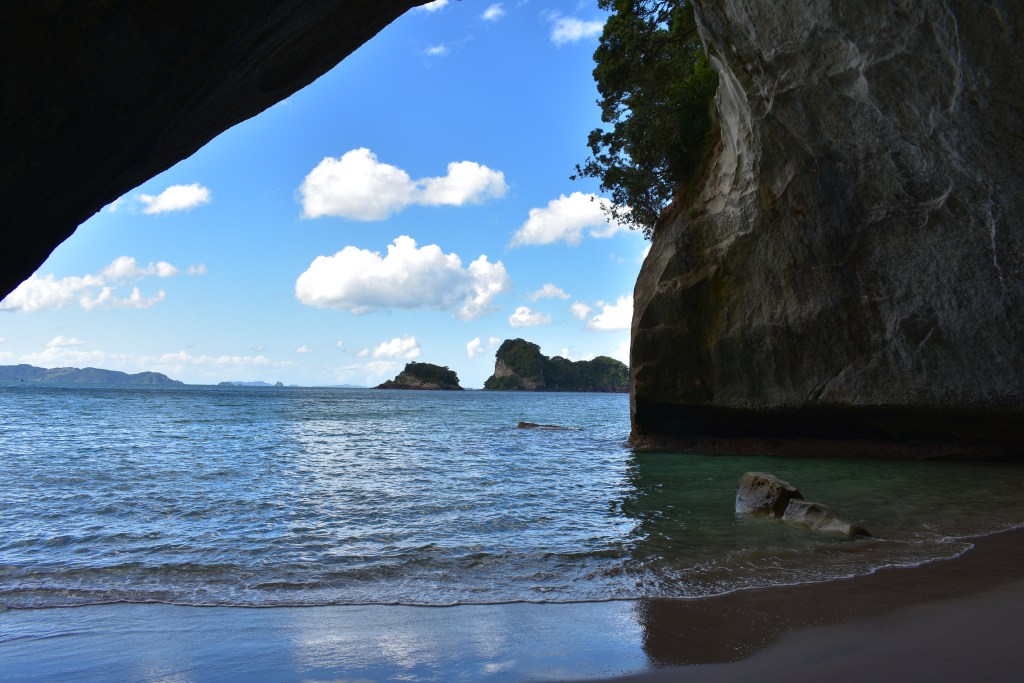
On the way back I chatted to a German woman whose English, unusually, wasn’t good and as I speak no German it was difficult but we got by.
I was in desperate need of a shower before going out for dinner at Manaia, the only restaurant that seemed to be open. I had the most lovely waiter, the food was delicious and the lady owner very friendly. The perfect end to another excellent day in the Coromandel.
It had rained a lot during the night and on Tuesday morning was pretty windy yet sunny and warm. I was moving on and staying the next 2 nights in Waihi, with previous Airbnb host Julie. I was once again feeling weary after a good walk the day before but thought I should stop along the way.
Mount Paku dominates Tairua and walking to the summit is another ‘must do’. I certainly didn’t fancy more uphill walking but drove around the estuary to it and up as far as I could and parked the car. Other people were walking from the bottom but there was no way I was doing that. From the car park it was just a steep 10-15 minute walk (for me) mainly up steps and it was so worth it. At the top a woman was coming down and we chatted. She said she had joined a 10 day challenge to walk from the bottom to the top and back down for 10 consecutive days and had to take a photo at the top each time to prove it. This was her 3rd day and she told me she was getting faster. Fair play to her because she was overweight but was enjoying the challenge which was then to be followed by a 5km then 10km run/walk. She said her name was Tia Logan, a 44 year old single mum of an 18 year old son. She’d moved to Tairua from Auckland 6 months previously as met her partner, a fisherman. She was interested in hearing about my travels and yearned to do some travelling herself now that her son could look after himself although her partner had teenagers so it might be a while before they could travel together.
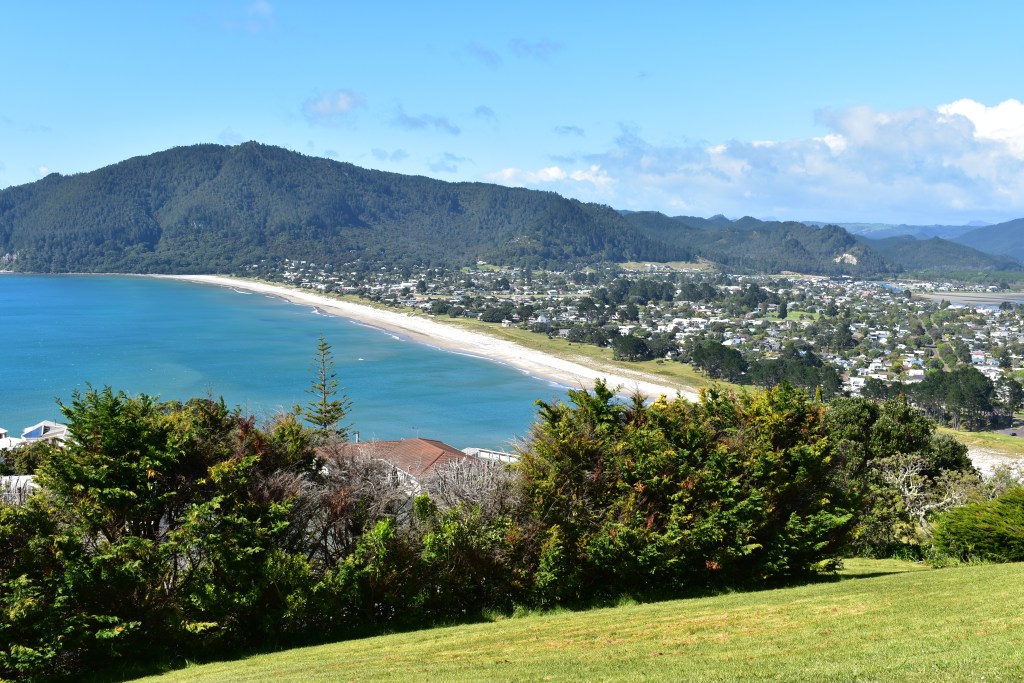

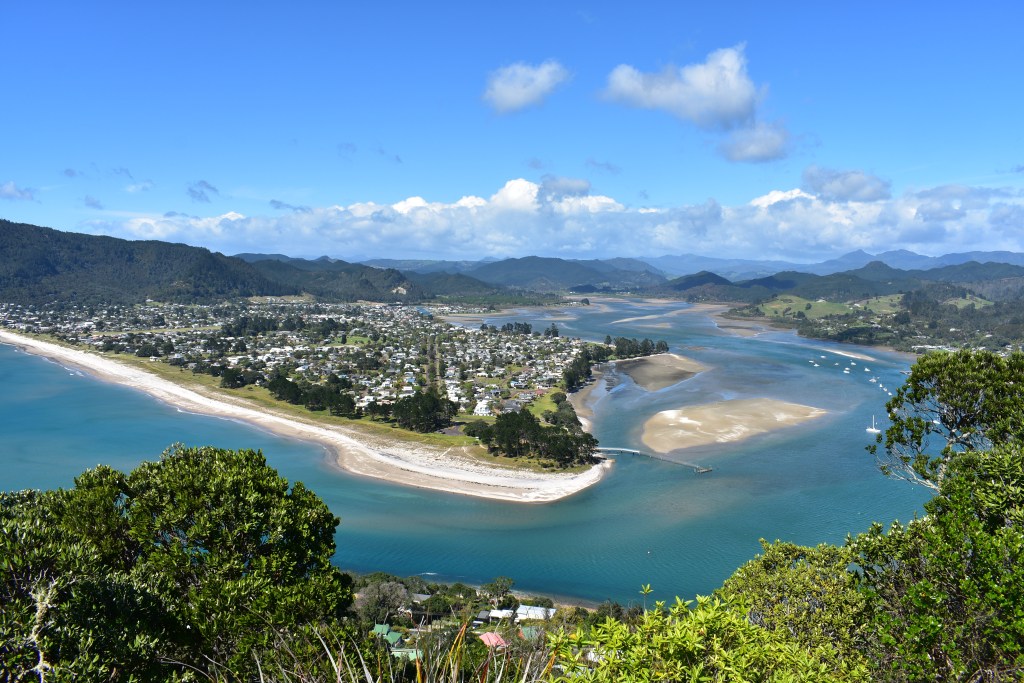
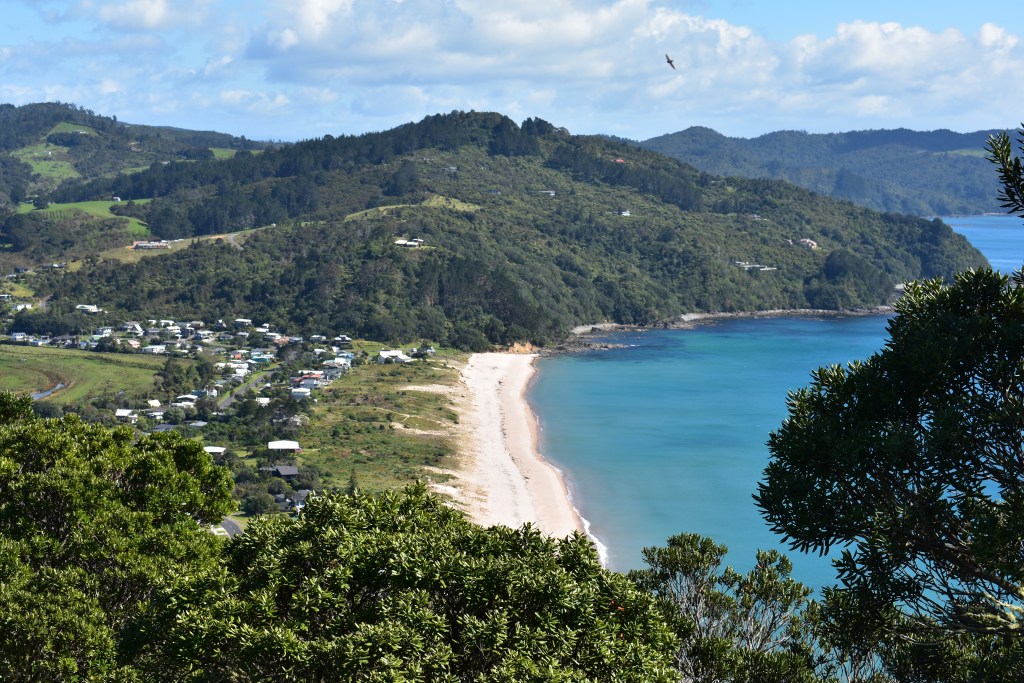
I then drove to Pauanui, where foot passengers can get to from Tairua in the summer by ferry as it’s just a short distance across the harbour but by road a distance of 25km. I’d been told by Leanne that it’s rather upmarket which was why she’d suggested Tairua would be the better place to stay. Pauanui is a purpose built holiday community and certainly some of the houses I passed were spectacular, especially those overlooking the South Pacific Ocean.
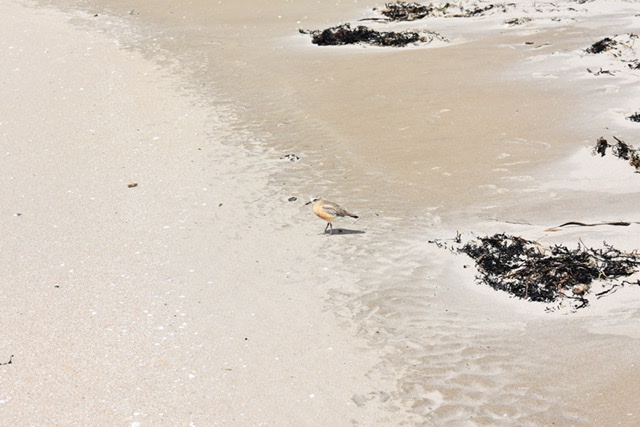
I parked the car and walked along the beach, which was pretty deserted save for a couple of variable oystercatchers and my first sighting of the rare and endangered northern NZ dotterel which I managed to sneak up on with my camera. The back of the beach was in fact a nesting area for them although I couldn’t see any others.

The next stop was Whangamata and Leanne had recommended a walk nearby but I was feeling a little weary. I had a wander along the main street and bought some long shorts as I’ve got no summer trousers just tee shirts. Then I drove to Waihi where I’d booked to stay again with Julie for 2 nights. We had our separate dinners together, for me a salad as I’d got a shock in the shop at how much weight I’d put on when I tried on a swimming costume. Not a pretty sight 😳
It rained in the night and the wind was howling. In the morning (Tuesday 22nd) it wasn’t much better. I had planned to go to Waihi Beach but decided instead to have a quiet day at Julie’s house while she was at work. I felt very lazy but probably needed a bit of a slow down after all the touring round and walking.
Here endeth this post. On with the next adventure!
 NeverSayNeverNomad